No fluff. Just the config that works.
Executive Summary
Every firewall advisory, every scanner finding and every “patch this now” email you send a customer hangs off one string: a CVE ID. Most of us read them all day without ever looking at the machinery behind them. This post walks the full CVE lifecycle from the moment a bug is found to the moment it lands in your scanner, and covers the organizations that run it, the numbering scheme, how severity ratings are produced with CVSS, how root causes are tagged with CWE, and the supporting systems (NVD, CPE, KEV, EPSS, SSVC) that turn a bare ID into something you can prioritize.
Objective: understand exactly who creates a CVE, what is inside a CVE record, what each score actually means, and how to pull all of it yourself from the command line.
Target audience: security engineers, SEs, SOC analysts and vulnerability management owners who consume CVE data daily and want to read it correctly, especially now that the NVD no longer enriches every record.
Prerequisites and Architecture
Assumed knowledge: basic vulnerability management concepts, JSON, and comfort with a terminal.
Lab requirements: any macOS or Linux host (or WSL) with curl and jq installed, and outbound HTTPS. No accounts or API keys are needed for the read-only queries in this post.
| Component | Who runs it | What it does |
|---|---|---|
| CVE Program | Sponsored by CISA, operated by MITRE as Secretariat | Assigns IDs and publishes the authoritative CVE List |
| CNA (CVE Numbering Authority) | Vendors, CERTs, researchers, bug bounty platforms | Assigns CVE IDs and writes the record within its scope |
| Root / Top-Level Root | MITRE and CISA (TL-Roots), plus Roots such as ENISA, Google, Red Hat, JPCERT/CC | Recruits, trains and governs the CNAs below it |
| CNA of Last Resort (CNA-LR) | MITRE and Red Hat | Catches reports no other CNA covers |
| ADP (Authorized Data Publisher) | CISA (Vulnrichment) | Adds data to a record without touching the CNA’s content |
| NVD | NIST | Downstream database that enriches CVEs with CPE, CVSS and CWE |
| CVSS and EPSS | FIRST | Severity scoring standard and exploit probability model |
| CWE | MITRE | Catalog of weakness types (root causes) |
| KEV Catalog | CISA | List of CVEs with confirmed exploitation in the wild |
Who Is Behind CVE
The CVE Program has been run by MITRE under a US government contract since its inception in 1999, with CISA as its sponsor. That single-sponsor model nearly broke in April 2025, when MITRE warned the CVE Board that its contract would lapse on April 16. CISA exercised an option period on the contract within hours, which carried the program to March 16, 2026.
That cliff never came. CVE Board members were told in January 2026 that there would be no funding cliff in March, and the contract was renewed under what sources describe as a more durable arrangement. The scare still left marks: some board members founded the CVE Foundation to push for diversified funding and vendor-neutral governance, and in mid-2026 a House amendment proposed formally authorizing CVE inside DHS with a 15-member policy board (it did not get a floor vote).
The program itself keeps growing. More than 530 CNAs now participate. ENISA became the second organization to hold Root status in November 2025 and is onboarding European CNAs under its own Root. Governance is also shifting: the CNA Operational Rules v4.2.1 (effective October 20, 2026) are now managed and approved by the “CVE Program Executive Committee (ESG),” while older program pages still describe the CVE Board in that role. If you build processes around CVE governance, check the current rules document rather than older blog posts.
Key point for customer conversations: MITRE does not write most CVEs. The vendor usually does. When you read a Fortinet, Palo Alto or Cisco CVE, the vendor’s PSIRT acting as a CNA wrote that record, chose the CWE and scored it.
The CVE Lifecycle: How a CVE Is Created
Stage 1: Discovery
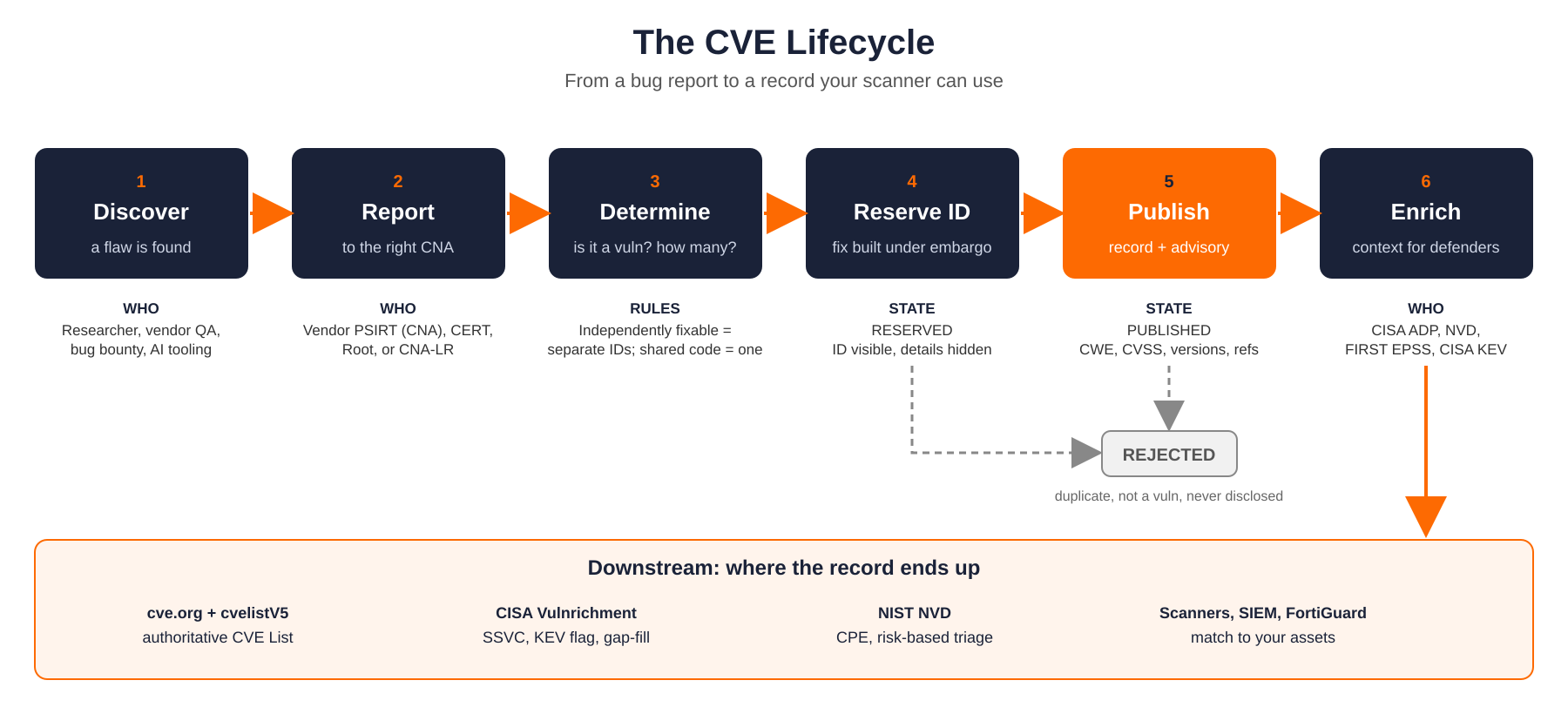
Goal: a flaw is found. Who: an internal QA team, an external researcher, a bug bounty hunter, an AI-assisted scanner, or an attacker (in which case defenders find out from incident response). Nothing about the CVE exists yet.
Stage 2: Report to the right CNA
Goal: get the bug to an organization that can assign an ID. Action: the finder reports to the vendor’s PSIRT. If the vendor is a CNA, it handles assignment. If not, the report goes to the CNA whose scope covers that product, such as a national CERT or a Root, and if no one covers it, to a CNA of Last Resort.
Stage 3: Vulnerability determination and counting
Goal: decide whether this is a vulnerability at all, and how many IDs it needs. The CNA rules define a vulnerability as an instance of one or more weaknesses in a product that can be exploited. Counting follows a few hard rules:
- Bugs that are independently fixable get separate IDs.
- If several products are vulnerable because they share the same vulnerable code, the CNA must assign one ID and share it across them.
- If the CNA is unsure whether two issues are independently fixable, it assigns a single ID.
- IDs identify vulnerabilities, not fixes. One patch that fixes five bugs still means five CVEs.
Stage 4: Reserve the ID
Goal: lock in an identifier while the fix is built under embargo. The CNA pulls an ID from its block, and the record sits in the RESERVED state. Anyone can see that the ID exists, but nothing about it is public. This is why you will sometimes see a CVE-2024 ID get published in 2026.
Stage 5: Publish the record
Goal: disclose. When the advisory goes out, the CNA publishes the CVE record. Per the CNA rules, a record must include at minimum:
- Enough information to uniquely identify the vulnerability.
- At least one affected product (supplier, product name, versions or dates).
- The vulnerability type or root cause, ideally as a CWE.
- An English prose description.
- At least one public reference other than the CVE record itself.
Most mature CNAs also add a CVSS vector and fixed versions. The record state moves to PUBLISHED.
Stage 6: Enrichment and downstream consumption
Goal: add the context defenders need. The record propagates to the CVE List on cve.org and the cvelistV5 GitHub repository. ADPs such as CISA add SSVC decision points, KEV status, and missing CVSS, CWE or CPE data. The NVD may enrich it further. Scanners, SIEMs, FortiGuard and every other feed pick it up from there.
Record states after publication
- REJECTED: the ID should not have been used (duplicate, not a vulnerability, never disclosed). The ID is burned and never reused.
- Disputed: a tag, not a state. The record stays published, but the vendor or another party disagrees that it is a real vulnerability.
The CVE Numbering Scheme
A CVE ID has three parts:
CVE-2024-21762
 |    |     |
 |    |     +-- sequence number: 4 or more digits
 |    +-------- year
 +------------- fixed prefix
The sequence number is variable length. The original format allowed only four digits, which capped the program at 9,999 IDs per year. The syntax change took effect on January 1, 2014, and the first IDs using the new syntax were issued on January 13, 2015. The rules:
- Sequence numbers 1 through 999 are zero-padded to four digits (
CVE-2026-0042). - 10,000 and above simply grow (
CVE-2026-12345,CVE-2026-111357). There is no upper limit, and six-digit IDs are routine in 2026.
The year is not the discovery year. Under rule 4.2.19, the year reflects when the vulnerability was first publicly disclosed, when the record was first published, or when the ID was reserved. A published ID is never renumbered to “fix” the year.
The number is not a timestamp. CNAs receive blocks of IDs, so a higher number does not mean a later disclosure, and gaps in the sequence are normal.
A correct validation regex:
grep -Eo 'CVE-[0-9]{4}-(0[0-9]{3}|[1-9][0-9]{3,})' advisory.txtVolume is the real story here. CVE submissions grew 32 percent in 2024, FIRST forecast a record of more than 50,000 new CVEs for 2026, and by September 2026 more than 67,000 had already been published.
Anatomy of a CVE Record
Records are JSON (CVE Record Format 5.x). The design matters because it explains why the same CVE can carry two different scores.
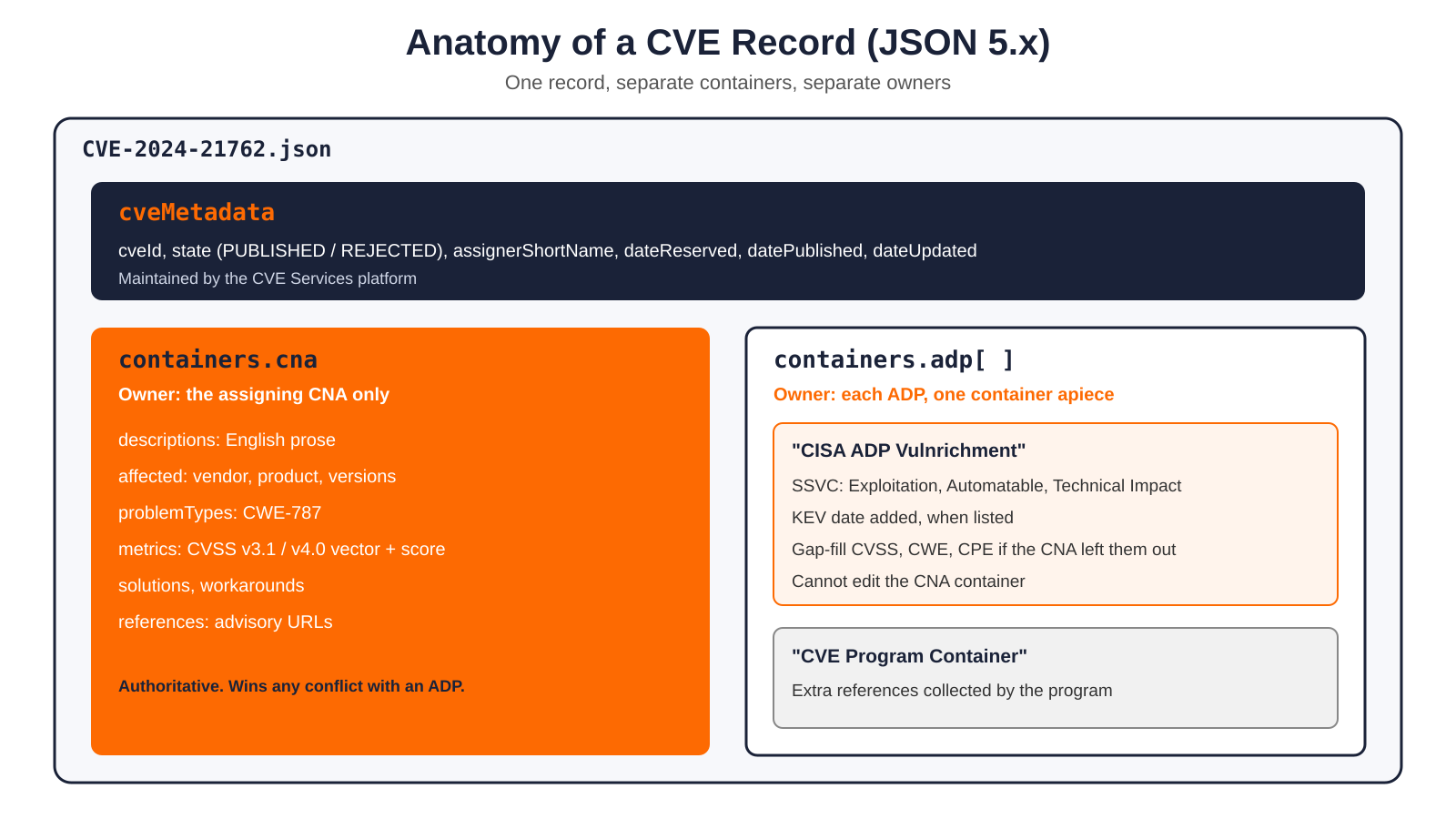
cveMetadata: the ID, state (PUBLISHED,REJECTED), the assigning CNA, and dates.containers.cna: owned only by the CNA. Description, affected products and versions,problemTypes(CWE),metrics(CVSS), references.containers.adp[]: one container per ADP. An ADP can add data but cannot modify the CNA container. CISA’s Vulnrichment container lives here, and if the CNA later supplies its own CVSS, CWE or CPE, the CNA data takes precedence.
CVSS: How Severity Ratings Work
The Common Vulnerability Scoring System is maintained by FIRST. It captures the technical characteristics of a vulnerability and produces a 0.0 to 10.0 score.
Versions in the wild: CVSS v3.1 (2019) is still the most common in records and tooling. CVSS v4.0 was released on November 1, 2023, and a growing number of CNAs publish v4.0 vectors alongside or instead of v3.1.
CVSS v4.0 metric groups:
| Group | Purpose | Who sets it |
|---|---|---|
| Base | Intrinsic properties of the flaw | CNA or vendor |
| Threat | Exploit Maturity (Attacked, POC, Unreported); replaces v3 Temporal | Consumer, changes over time |
| Environmental | Your controls and asset importance | You |
| Supplemental | Extra context (Automatable, Recovery, Safety, etc.) that does not change the score | CNA or consumer |
Base metrics in v4.0: Attack Vector (AV), Attack Complexity (AC), the new Attack Requirements (AT), Privileges Required (PR), User Interaction (UI), plus impact to the Vulnerable System (VC, VI, VA) and to Subsequent Systems (SC, SI, SA), which replaces the old Scope metric.
CVSS:4.0/AV:N/AC:L/AT:N/PR:N/UI:N/VC:H/VI:H/VA:H/SC:N/SI:N/SA:NNew naming: v4.0 labels what was actually scored. CVSS-B is Base only, CVSS-BT adds Threat, CVSS-BE adds Environmental, and CVSS-BTE is all three. A number in a vendor advisory is almost always CVSS-B.
Qualitative ratings (unchanged from v3.x):
| Rating | Score range |
|---|---|
| None | 0.0 |
| Low | 0.1 to 3.9 |
| Medium | 4.0 to 6.9 |
| High | 7.0 to 8.9 |
| Critical | 9.0 to 10.0 |
Who scores it now: the CNA. Since April 15, 2026, NIST no longer routinely issues its own separate NVD severity score; you can request one for a specific CVE by email. The “NVD score vs vendor score” mismatch you used to explain to customers is going away, because increasingly there is only the vendor score.
CVSS measures severity, not risk. FIRST has said this since v3.1. A 9.8 on an internal lab box can matter less than a 6.5 on an internet-facing SSL VPN that is being exploited today.
CWE: The Root Cause Behind the CVE
If CVE answers “which bug?”, CWE answers “what kind of mistake?” The Common Weakness Enumeration, also run by MITRE, catalogs weakness types in software and hardware. A weakness is the coding or design flaw class (for example, CWE-787 Out-of-bounds Write). A vulnerability is a specific instance of that weakness in a specific product (CVE-2024-21762 in FortiOS SSL VPN).
CWE entries are organized in a hierarchy from abstract Pillars down to Classes, Bases and Variants. CNAs are expected to map to the most specific level they can; Pillar-level mappings are rarely useful for root cause analysis.
The 2025 CWE Top 25 was built from the CWEs behind 39,080 CVE records. The top ten:
| Rank | CWE | Weakness |
|---|---|---|
| 1 | CWE-79 | Cross-site Scripting |
| 2 | CWE-89 | SQL Injection |
| 3 | CWE-352 | Cross-Site Request Forgery |
| 4 | CWE-862 | Missing Authorization |
| 5 | CWE-787 | Out-of-bounds Write |
| 6 | CWE-22 | Path Traversal |
| 7 | CWE-416 | Use After Free |
| 8 | CWE-125 | Out-of-bounds Read |
| 9 | CWE-78 | OS Command Injection |
| 10 | CWE-94 | Code Injection |
MITRE also publishes a Top 10 KEV Weaknesses list using the same method, which is the more useful list if you care about what attackers actually use. A close relative, CAPEC (Common Attack Pattern Enumeration and Classification), catalogs the attack techniques that exploit these weaknesses.
The Supporting Cast: NVD, CPE, KEV, EPSS, SSVC
NVD (NIST)
The National Vulnerability Database is downstream of CVE, not the source of it. NIST is not a CNA. For years the NVD added CPE product strings, its own CVSS score and CWE to every CVE. A backlog began in February 2024 and never cleared. On April 15, 2026, NIST switched to risk-based triage and now prioritizes enrichment for:
- CVEs in the CISA KEV Catalog (goal: within one business day).
- CVEs in software used by the federal government.
- CVEs in critical software as defined by Executive Order 14028.
Everything else is still published in the NVD but labeled lowest priority, and roughly 29,000 backlogged CVEs published before March 1, 2026 were moved to “Not Scheduled.”
CPE
Common Platform Enumeration is the machine-readable product name scanners use to match a CVE to your asset, in the form cpe:2.3:o:fortinet:fortios:7.4.2:*:*:*:*:*:*:*. With the NVD’s change, CPE coverage is the biggest practical gap: one analysis found the NVD supplied CPEs for only about 41 percent of published vulnerabilities. Expect your scanner vendor’s own enrichment, ADP data and CNA-supplied product data to matter more.
KEV (CISA)
The Known Exploited Vulnerabilities Catalog lists CVEs with confirmed exploitation in the wild. Three criteria must all be met: an assigned CVE ID, reliable evidence of active exploitation (a proof of concept or scanning alone does not count), and clear remediation guidance. On June 10, 2026, CISA issued BOD 26-04, which replaced BOD 22-01 as the directive behind KEV for federal agencies and moved from fixed patch windows to risk-based ones, with deadlines as short as three days. The catalog is deliberately small, roughly 1,700 entries, which is exactly why it is the best first filter you have.
EPSS (FIRST)
The Exploit Prediction Scoring System is a machine-learning model that gives every published CVE a probability from 0 to 1 of exploitation in the wild over the next 30 days, plus a percentile. Scores update daily. EPSS v4 was released on March 17, 2025. Use it to rank the long tail that is not in KEV yet.
SSVC and CISA Vulnrichment
Stakeholder-Specific Vulnerability Categorization is a decision tree rather than a score. Through its Vulnrichment ADP container, CISA adds three SSVC decision points to records it analyzes: Exploitation (none, poc, active), Automatable (yes, no) and Technical Impact (partial, total), along with KEV data and missing CVSS, CWE or CPE.
Which data answers which question
| Question | Look at |
|---|---|
| Which bug is this? | CVE ID and CNA description |
| What kind of mistake caused it? | CWE |
| How bad is it technically? | CVSS (Base) |
| Does it affect my product version? | CNA affected versions, CPE |
| Is anyone exploiting it right now? | KEV, SSVC Exploitation |
| Is it likely to be exploited soon? | EPSS |
Verification and Validation: Pull It All Yourself
Use one CVE end to end. CVE-2024-21762, the FortiOS SSL VPN out-of-bounds write, works well because it has a vendor CNA record, a CWE, and a KEV listing.
1. Pull the authoritative record from the CVE Services API:
CVE="CVE-2024-21762"
curl -s "https://cveawg.mitre.org/api/cve/${CVE}" -o "${CVE}.json"
jq '.cveMetadata | {cveId, state, assignerShortName, datePublished}' "${CVE}.json"
Expected success output:
{
  "cveId": "CVE-2024-21762",
  "state": "PUBLISHED",
  "assignerShortName": "fortinet",
  "datePublished": "2024-02-09T08:14:25.954Z"
}
assignerShortName is fortinet: the vendor PSIRT, acting as a CNA, wrote this record. If the API is blocked on your network, the same JSON is mirrored in the CVE Project’s cvelistV5 GitHub repository: curl -s https://raw.githubusercontent.com/CVEProject/cvelistV5/main/cves/2024/21xxx/CVE-2024-21762.json.
2. Read the CNA’s CWE and CVSS:
jq -r '.containers.cna.problemTypes[].descriptions[] | "\(.cweId) \(.description)"' "${CVE}.json"
jq '.containers.cna.metrics[] | to_entries[] | select(.key | startswith("cvss")) | {version: .key, vector: .value.vectorString, score: .value.baseScore, severity: .value.baseSeverity}' "${CVE}.json"
Expected success output:
CWE-787 Execute unauthorized code or commands
{
  "version": "cvssV3_1",
  "vector": "CVSS:3.1/AV:N/AC:L/PR:N/UI:N/S:U/C:H/I:H/A:H/E:H/RL:W/RC:C",
  "score": 9.6,
  "severity": "CRITICAL"
}
Two things to notice. The CWE ID is the standard one, but the description text is the CNA’s own wording, not the official CWE name (“Out-of-bounds Write”), so always key on the ID. And this vendor vector includes v3.1 Temporal metrics (E:H/RL:W/RC:C), yet the baseScore field is still the Base score.
3. Read CISA’s SSVC decision points from the ADP container:
jq '.containers.adp[]? | select(.title == "CISA ADP Vulnrichment") | .metrics[]?.other? | select(.type == "ssvc") | .content.options' "${CVE}.json"Expected success output:
[
  { "Exploitation": "active" },
  { "Automatable": "yes" },
  { "Technical Impact": "total" }
]
Active exploitation, automatable, total impact: in SSVC terms this is an act-now item regardless of anything else.
4. Check KEV status:
curl -s https://www.cisa.gov/sites/default/files/feeds/known_exploited_vulnerabilities.json \
  | jq --arg c "$CVE" '.vulnerabilities[] | select(.cveID == $c) | {cveID, dateAdded, knownRansomwareCampaignUse, requiredAction}'
Expected success output: one object with the date CISA added it. No output means the CVE is not in KEV.
5. Check EPSS probability:
curl -s "https://api.first.org/data/v1/epss?cve=${CVE}" | jq '.data[0] | {cve, epss, percentile, date}'Expected success output: an epss value between 0 and 1 and a percentile, dated today.
6. Check NVD enrichment status:
curl -s "https://services.nvd.nist.gov/rest/json/cves/2.0?cveId=${CVE}" | jq '.vulnerabilities[0].cve | {vulnStatus, cpeMatches: ([.configurations[]?.nodes[]?.cpeMatch[]?] | length)}'Expected success output: a vulnStatus value and a count of CPE matches. A KEV-listed CVE like this one should be analyzed; for a random low-profile CVE from 2026, expect a lowest priority or not scheduled status and zero CPEs.
Troubleshooting and Gotchas
Gotcha 1: Truncated or rejected CVE IDs in your tooling
Symptom: a script, spreadsheet or ticketing integration turns CVE-2026-111357 into CVE-2026-1113, which is a different, valid CVE. Excel can also strip leading zeros from IDs like CVE-2026-0042 if the field is split.
Diagnostic:
grep -Eo 'CVE-[0-9]{4}-[0-9]+' export.csv | awk -F- 'length($3) < 4 || length($3) > 7' | sort -uFix: treat CVE IDs as strings, never numbers, and validate with the regex from the numbering section. Sort on the numeric value of the sequence only when you need ordering, and remember ordering does not equal disclosure date.
Gotcha 2: “No CVSS” or “No CPE” findings since April 2026
Symptom: a scanner or dashboard shows a new CVE with no score or no affected products, and the team assumes it is low risk.
Diagnostic: check whether the data exists upstream in the CNA or ADP container rather than in the NVD:
jq '{cna_metrics: (.containers.cna.metrics // [] | length), adp_titles: [.containers.adp[]?.title]}' "${CVE}.json"Fix: configure tools to consume CNA and ADP data (cvelistV5 or the CVE Services API) instead of relying only on NVD fields, and treat “unscored” as unknown, not low.
Gotcha 3: Prioritizing by CVSS alone
Symptom: the team burns a sprint on 9.8s that nobody exploits while a 7.x on the edge firewall is in KEV.
Fix: use a simple order of operations: KEV first (especially on internet-facing assets), then high EPSS, then CVSS Base plus your own asset criticality. If you want a formal model, SSVC gives you defensible decisions rather than a number.
For worked examples of this order of operations on real advisories, see Countermeasures for pre-auth Fortinet PSIRT vulnerabilities and Node2Shell (CVE-2026-111497) mitigation with Fortinet.
Sources
- CISA extends CVE program contract with MITRE for 11 months (The Record)
- Policy Pulse Issue 8: CVE program funding secured (disclose.io)
- Key cybersecurity system getting closer look from Congress (Government Executive)
- CISA wants to maintain government control of CVE program (The Register)
- CVE Program structure (cve.org)
- CNA Operational Rules v4.2.1 (cve.org, PDF)
- New CVE Numbering Authorities under ENISA Root (ENISA)
- CVE ID Syntax Change, archived (MITRE)
- Technical Guidance for Handling the New CVE ID Syntax, archived (cve.org)
- AI companies to play bigger role in CVE Program (Infosecurity Magazine)
- CISA publishes framework for improving CVE program (SC Media)
- NIST still struggling to clear NVD backlog (SecurityWeek)
- CVSS v4.0 overview (FIRST)
- CVSS v4.0 Specification Document (FIRST)
- FIRST announces CVSS 4.0 (The Hacker News)
- What’s new in CVSS 4.0 (Snyk)
- 2025 CWE Top 25 Most Dangerous Software Weaknesses (MITRE)
- 2025 CWE Top 25 Key Insights (MITRE)
- 2025 CWE Top 10 KEV Weaknesses Insights (MITRE)
- CRACI: How CWE IDs show up in CVE records
- NIST updates NVD operations to address record CVE growth (NIST)
- NIST officially stops enriching most CVEs (Socket)
- NVD Enrichment Triage: Enterprise vulnerability programs must adapt (Cloud Security Alliance)
- Known Exploited Vulnerabilities Catalog (CISA)
- CISA releases BOD 26-04 on prioritizing security updates based on risk (CISA)
- CISA directive highlights risk-based vulnerability management (Wiley)
- CISA KEV glossary entry (Socket)
- Exploit Prediction Scoring System (FIRST)
- Introducing EPSS Version 4 (Empirical Security)
- CISA Vulnrichment repository (GitHub)
- Unlocking Vulnrichment: Enriching CVE Data (CISA)
- CVE counting rules, archived (MITRE)