
If you've spent any time configuring user authentication on... Full Story
By Manny Fernandez
October 27, 2026
Blockchain Explained for Beginners: How It Works, Minus the Hype
Blockchain Explained for Beginners: How It Works, Minus the Hype
No fluff. Just the config that works. This one has no firewall config at all, just the plain-English version of a word everybody uses and almost nobody explains.
Executive Summary
Objective: Explain what a blockchain is, how it works under the hood, and where it actually makes sense, using everyday analogies first and the real terms second.
Target audience: Anyone who has heard “blockchain” in a meeting, a news story, or a sales pitch and nodded along. No math, coding, or crypto background needed.
What you will be able to do: Describe blockchain in one sentence, explain why the records are so hard to change, tell proof of work from proof of stake, and spot the claims that are hype.
Here is blockchain explained in one sentence: a blockchain is a shared record book that many computers keep identical copies of, where every new page is mathematically sealed to the page before it, so nobody can quietly rewrite history. That is it. Everything else in this post is the detail behind that sentence.
NIST, the U.S. standards agency, describes blockchains as tamper evident and tamper resistant digital ledgers that are spread across many computers instead of sitting in one central place, and that usually run without a central authority such as a bank, company, or government (NIST IR 8202). Keep that definition handy. We are going to unpack each word in it.
Prerequisites and Architecture
Assumed knowledge
None. If you can follow a group chat and understand what a receipt is, you have enough. The optional hands-on section uses a terminal (Terminal on macOS, any Linux shell, or PowerShell on Windows), but you can skip it and still get the full picture.
The analogy we will use throughout
Picture a neighborhood that shares one notebook of IOUs. Instead of one person holding the notebook (who could cheat), everyone on the street keeps their own identical copy. When someone writes a new line, they read it out loud, everyone checks it makes sense, and everyone adds it to their copy. If one neighbor secretly edits their copy, it no longer matches the other 50 copies, and everyone ignores it.
A blockchain is that notebook, run by computers, with math doing the “checking” so nobody has to trust anybody’s honesty.
Component table
| Component | Plain-English meaning | Notebook analogy |
|---|---|---|
| Ledger | A list of records, usually transactions (who sent what to whom) | The notebook itself |
| Transaction | One record, such as “Alice pays Bob 5” | One line in the notebook |
| Block | A batch of transactions bundled together | One page of lines |
| Hash | A short digital fingerprint calculated from data | A wax seal that cracks if the page changes |
| Chain | Each block stores the previous block’s hash, linking them in order | Every page’s seal includes the previous page’s seal |
| Node | A computer that keeps a full copy and checks new blocks | A neighbor with their own copy |
| Consensus | The rules nodes follow to agree on the next block | How the street decides whose page gets added |
| Keys and wallet | A private key signs your transactions; a wallet is the app that holds it | Your signature, plus the pen you keep in your pocket |
Blockchain Explained, Step by Step: How It Works
Five building blocks make the whole thing work. Each step below follows the same pattern: the goal, what actually happens, and a way to see it for yourself.
Step 1: Hashes, the digital fingerprint
Goal: Understand the single trick that makes blockchain tamper evident.
Action: A hash function takes any input (a word, a page, a whole movie) and produces a fixed-length fingerprint. The same input always gives the same fingerprint. Change even one character and the fingerprint changes completely and unpredictably. You also cannot work backward from the fingerprint to the original data.
Try it. These are real SHA-256 fingerprints, the same hash family Bitcoin uses. Notice that adding a capital letter or a single period produces a totally different result:
macOS Terminal
echo -n "hello" | shasum -a 256
2cf24dba5fb0a30e26e83b2ac5b9e29e1b161e5c1fa7425e73043362938b9824  -

echo -n "Hello" | shasum -a 256
185f8db32271fe25f561a6fc938b2e264306ec304eda518007d1764826381969  -

echo -n "hello." | shasum -a 256
1589999b0ca6ef8814283026a9f166d51c70a910671c3d44049755f07f2eb910  -
On Linux, swap shasum -a 256 for sha256sum. On Windows PowerShell, these four lines do the same job (it prints the same fingerprint as the first example above):
Windows PowerShell
$s = "hello"
$bytes = [Text.Encoding]::UTF8.GetBytes($s)
$hash = [Security.Cryptography.SHA256]::Create().ComputeHash($bytes)
($hash | ForEach-Object { $_.ToString("x2") }) -join ""
Why it matters: If anyone changes a record, its fingerprint changes, and that change is instantly visible to everyone comparing fingerprints. That is what “tamper evident” means.
Step 2: Blocks are chained by their fingerprints
Goal: See why changing an old record is so hard.
Action: Each new block contains its own transactions plus the fingerprint of the block before it. So block 3’s fingerprint depends on block 2’s, which depends on block 1’s. Edit block 1 and its fingerprint changes, which means block 2 now points at a fingerprint that no longer exists, which breaks block 3, and so on down the line.
Figure 1: Each block carries the previous block’s hash. Change one block and every link after it breaks.
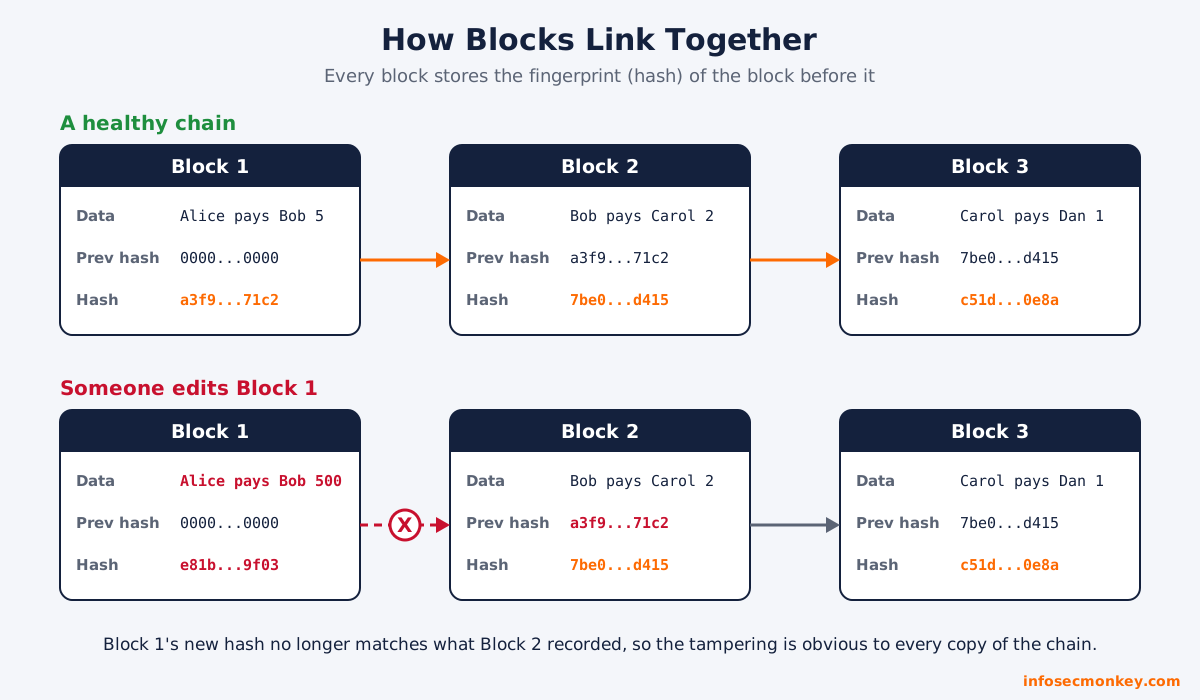
A cheater would have to rebuild every block after the one they changed, and then convince the rest of the network to accept their rewritten copy. Steps 3 and 4 are what make that practically impossible.
Step 3: Everyone keeps a copy (decentralization)
Goal: Understand why there is no single place to attack or bribe.
Action: Thousands of independent computers (nodes) each store the full chain and check every new block against the rules. There is no master copy. If your copy disagrees with everyone else’s, the network simply treats yours as wrong.
This is the part that was genuinely new in 2008. On October 31, 2008, someone using the name Satoshi Nakamoto posted a short message to a cryptography mailing list announcing an electronic cash system that was fully peer to peer, with no trusted third party (original announcement). The paper it linked to is the Bitcoin whitepaper, and the first real-world blockchain came out of it.
Step 4: Consensus, deciding who adds the next page
Goal: Learn how strangers who do not trust each other agree on one version of history.
Action: If anyone could add a block at any time, the notebook would be chaos. Consensus mechanisms are the rules for picking who writes the next block and for making cheating expensive. The two you will hear about most:
| Proof of Work (PoW) | Proof of Stake (PoS) | |
|---|---|---|
| Used by | Bitcoin | Ethereum (since 2022) |
| Who adds the next block | Whoever first solves a hard guessing puzzle using computing power (“mining”) | A validator picked at random from people who locked up coins as collateral |
| What a cheater risks | The electricity and hardware spent on puzzles that the network rejects | The coins they locked up, which can be destroyed (“slashed”) |
| Main criticism | Uses a lot of energy | Newer and more complex than proof of work |
In proof of work, the whitepaper’s design is that the longest chain wins, because it represents the most computing effort, and attackers would have to outpace all the honest computers combined to rewrite it (Bitcoin whitepaper).
In proof of stake, Ethereum validators deposit 32 ETH into a contract and can lose some or all of it if they try to defraud the network. Ethereum made the switch from proof of work in September 2022, and its block schedule runs on fixed 12-second slots instead of puzzle difficulty (ethereum.org).
Either way, the idea is the same: make honesty the cheapest option. Cheating costs real money, so rational people do not bother.
Step 5: Keys and signatures, proving it is really you
Goal: Understand how a blockchain knows a transaction is legitimate without asking for your name.
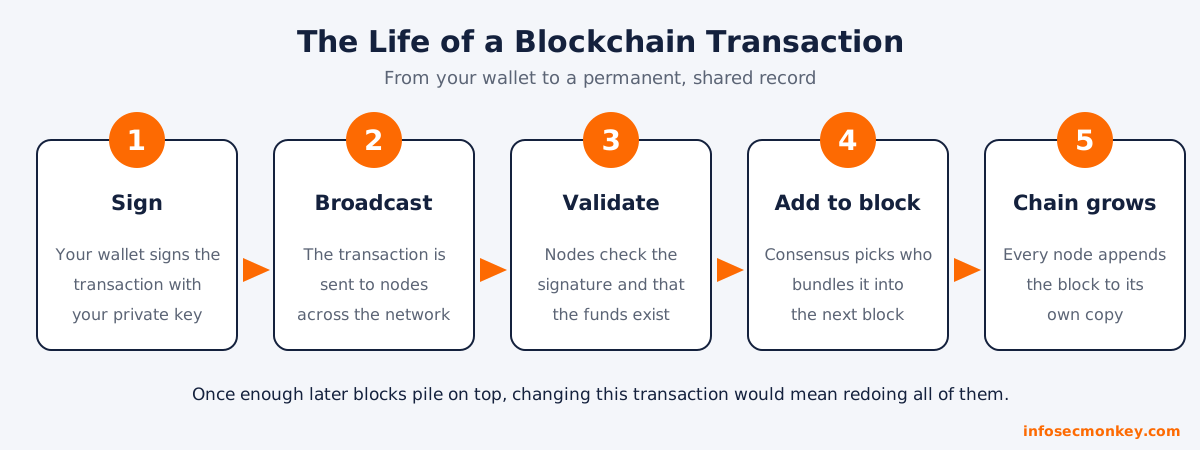
Action: You get two linked keys. Your public key (turned into an address) is like your mailbox number: you can share it with anyone. Your private key is like the only key that opens that mailbox: you never share it. When you send something, your wallet uses the private key to digitally sign the transaction, and anyone can use your public key to confirm the signature is genuine.
The private key IS the money. Whoever holds it controls the funds. There is no “forgot my password” button and no bank to call.
Figure 2: The life of a transaction, from your wallet to a permanent block.
Where Blockchain Fits, and Where It Does Not
Blockchain solves one specific problem very well: keeping a shared record honest when the people involved do not trust each other and do not want a middleman. That makes it a good fit for some jobs and a bad fit for many others.
| Good fit | Poor fit |
|---|---|
| Digital money moved directly between strangers (Bitcoin) | A single company’s internal database (one owner means no trust problem to solve) |
| Records many organizations need to share and audit, such as some supply chain tracking | Anything that needs to delete data on request, such as personal records under privacy laws |
| Programmable agreements that run automatically (“smart contracts” on Ethereum) | High-speed systems that need thousands of updates per second at low cost |
| Public, verifiable timestamps that prove a document existed at a point in time | Situations where the data going in cannot be verified (bad data in stays bad forever) |
A useful gut check: if you could replace the blockchain with a shared spreadsheet that one trusted party manages, you probably should.
Organizations can also choose between permissionless blockchains, where anyone can join and add blocks (Bitcoin, Ethereum), and permissioned blockchains, where only approved participants can write. NIST covers both models and when each makes sense (NIST IR 8202).
Verification and Validation: Build a Tiny Blockchain
Want proof that the “one edit breaks the chain” idea is real? This short Python script builds a three-block chain, checks it, then quietly edits the first block and checks it again. It runs on any Mac or Linux machine with Python 3, no extra installs.
mini_chain.py
import hashlib

def h(text):
    return hashlib.sha256(text.encode()).hexdigest()

# Build a 3-block chain. Each block stores the previous block's fingerprint.
chain = []
prev = "0" * 64
for data in ["Alice pays Bob 5", "Bob pays Carol 2", "Carol pays Dan 1"]:
    block = {"data": data, "prev": prev}
    block["hash"] = h(block["data"] + block["prev"])
    chain.append(block)
    prev = block["hash"]

def check(chain):
    for i, b in enumerate(chain):
        if h(b["data"] + b["prev"]) != b["hash"]:
            return f"Block {i} is BROKEN (its contents changed)"
        if i > 0 and b["prev"] != chain[i-1]["hash"]:
            return f"Block {i} is BROKEN (its link no longer matches)"
    return "Chain is valid"

for i, b in enumerate(chain):
    print(f"Block {i}: {b['data']:<18} hash={b['hash'][:16]}...")
print(check(chain))

# Now cheat: rewrite history in block 0
chain[0]["data"] = "Alice pays Bob 500"
print("After editing block 0:", check(chain))
Run it:
Terminal
python3 mini_chain.pyExpected success output (your hashes will match, because the inputs are the same):
Output
Block 0: Alice pays Bob 5   hash=f2997504ac036866...
Block 1: Bob pays Carol 2   hash=d89d90d3ed5225a4...
Block 2: Carol pays Dan 1   hash=d68429e65bbc3efb...
Chain is valid
After editing block 0: Block 0 is BROKEN (its contents changed)
The cheater changed 5 to 500, and the chain caught it immediately. To get away with it, they would need to recalculate every later block AND convince thousands of other computers to adopt their copy. That is the whole security model in one script.
Troubleshooting and Gotchas: The Myths That Trip People Up
Gotcha 1: “Blockchain can’t be hacked, so crypto is safe”
The reality: The chain itself is very hard to alter. The things around it, such as wallets, exchanges, phishing sites, and people, get compromised constantly. Most losses come from someone being tricked into handing over a private key or sending funds to a scammer.
The numbers: The FBI’s Internet Crime Complaint Center logged 181,565 cryptocurrency-related complaints in 2025 with reported losses of about $11.4 billion, and crypto investment fraud alone accounted for $7.2 billion (The Block, covering the IC3 2025 report).
The fix: Never share a seed phrase or private key with anyone, including “support”. Treat any unsolicited investment opportunity paid in crypto as a scam until proven otherwise. Remember that blockchain transactions generally cannot be reversed.
Gotcha 2: “Blockchain and Bitcoin are the same thing”
The reality: Bitcoin is one application that runs on one blockchain. Blockchain is the underlying record-keeping technique, and many other systems use it, including Ethereum and private permissioned ledgers.
The fix: When someone pitches “blockchain”, ask which blockchain, who runs the nodes, and what problem a normal database could not solve.
Gotcha 3: “It’s on the blockchain, so it must be true”
The reality: A blockchain proves a record has not been changed since it was written. It does not prove the record was accurate when it was written. Garbage in, permanent garbage out. Public blockchains are also not anonymous: every transaction is visible to everyone forever, linked to an address, so they are better described as pseudonymous.
The fix: Ask how data gets onto the chain and who vouches for it. And assume anything you do on a public chain can eventually be traced back to you.
The Takeaway
Strip away the hype and blockchain is three ideas stacked together: fingerprints that expose any change, copies everywhere so there is no single point of control, and consensus rules that make cheating cost more than it pays. That combination lets strangers share a trustworthy record without a middleman. It is clever, it is real, and it is not the answer to every problem. Now you can tell which is which.
Sources
- NIST IR 8202: Blockchain Technology Overview
- Satoshi Nakamoto, “Bitcoin P2P e-cash paper” (Cryptography Mailing List, October 31, 2008)
- Bitcoin: A Peer-to-Peer Electronic Cash System (whitepaper, reproduced in Mastering Bitcoin, Appendix A)
- ethereum.org: Proof-of-stake (PoS)
- The Block: FBI says crypto-related fraud losses hit record $11.4 billion in 2025 (IC3 2025 report coverage)
InfoSecMonkey: No fluff. Just the config that works.
Recent posts
-

-

DNS is one of those technologies that quietly underpins... Full Story
-

BGP issues on FortiGate firewalls usually trace back to... Full Story
-

Every time your laptop talks to your router, a... Full Story
-

If you've spent any time configuring NAT on a... Full Story
-

If you have spent any time configuring firewall policies... Full Story
-

High availability on FortiGate is one of those features... Full Story
-

If you've configured SD-WAN on a FortiGate, you've almost... Full Story
-

FortiLink is the management protocol that turns a FortiSwitch... Full Story
-

FortiSwitches are pretty rock solid from Mean Time Between... Full Story
-

This is a quicky tip. Have you ever gone... Full Story
-

DNS is one of those quiet pieces of internet... Full Story
-

This article is an updated version of the previous... Full Story
-

You will add ns2 as a secondary (slave) BIND9... Full Story
-

In the process of deploying my lab, I needed... Full Story
-

RFC 8805, used to be known as Self-Correcting IP... Full Story
-

Years back, I wrote an article about certificate pinning. ... Full Story
-

FortiGates have the ability to send alerts to Microsoft... Full Story
-

In this post, I am going to walk through... Full Story
-

Troubleshooting VoIP on a FortiGate can feel like trying... Full Story
-

Prior to FortiOS 7.0, there were three commands to... Full Story
-

In this post, I am going to go over... Full Story
-

What we are going to do: We are going... Full Story
-

Choosing between FGCP (FortiGate Clustering Protocol) and FGSP (FortiGate... Full Story
-

Creating a VLAN on macOS (The "Pro" Move) A... Full Story
-

This blog post explores the logic behind how macOS... Full Story
-

Pretty Fly for a Wi-Fi Tell My Wi-Fi Love... Full Story
-

Part of my daily gig is creating BoMs (Bill-of-Materials)... Full Story
-

ICMP introduces several security risks, but careful filtering, rate... Full Story
-

The command diag debug application dhcps -1 enables full... Full Story
-

In the world of FortiOS, execute tac report is... Full Story
-

LLDP; What is it The Link Layer Discovery Protocol... Full Story
-

What it actually does When you run diagnose fdsm... Full Story
-

Monkey Bites are bite-sized, high-impact security insights designed for... Full Story
-

I have run macOS in macOS with Parallels but... Full Story
-

Don't be confused with my other FortiNAC posts where... Full Story
-

This is the third session in a multi-part article... Full Story
-

Today I was configuring key-based authentication on a FortiGate... Full Story
-

Netcat, often called the "Swiss Army knife" of networking,... Full Story
-

At its core, IEEE 802.1X is a network layer... Full Story
-

In case you did not see the previous FortiNAC... Full Story
-

This is our 5th session where we are going... Full Story
-

Now that we have Wireshark installed and somewhat configured,... Full Story
-

The Philosophy of Packet Analysis Troubleshooting isn't about looking... Full Story
-

Blockchain Explained for Beginners: How It Works, Minus the... Full Story
-

No fluff. Just the config that works. The /31... Full Story
-

A practitioner guide to arp-scan network discovery on Linux... Full Story