
If you've spent any time configuring user authentication on... Full Story
By Manny Fernandez
October 11, 2016

MailTags in macOS Sierra
To follow up to my previous blog post regarding my workflow, I wanted to share a specific piece of that workflow. It is the use of MailTags 5 for Mail.app. This is an excellent tool that integrates with OmniFocus (Another one of the applications I listed in my previous blog posts. MailTags is a plugin for Mail.app which ships by default with macOS (Formerly OS X). Although Mail is extremely stable and obviously integrated at every level with the OS, it is very slow in adding features and functionality. Thankfully, they created the ability to have plugins. This is however not a perfect relationship as every new version of the OS, will break the plugins. I used to use many different plugins but now use three (2 active and one that has been broken since Sierra), Those plugins are, MailTags, GPG and MailButler (which I wrote about on a previous blog post).
Features:
Tagging Messages – You can tag messages or threads of messages and use smart searches to find all messages at a later time.
Ticklers – Allows you to tag a message that will pop-up later on and remind you of an action. This is necessary when you send an email that requires a follow up. Although MailButler has a similar feature, it adds it to the ‘To Do’ list instead of a pop up.
OmniFocus – MailTags also integrates with OmniFocus. It will pull active projects from OmniFocus and allow you ton tags the emails with those projects
Calendar – Allows you to create a calendar items or Task for that email you are sending
Note – Allows you to add a note.
—————————————————————————
This is my work flow:
If I receive a single email regarding a project or subject that I know will be drawn out issue, I will receive the email and tag it using the keyboard shortcut ^ ⌘ T (Control, Command T). This brings up the MailTag dialog box.
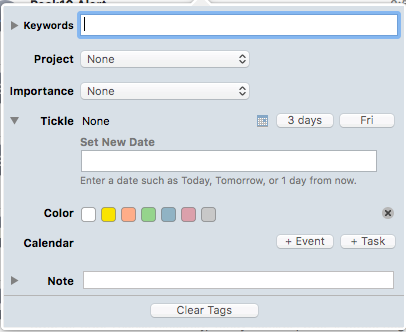
From here, I can add a keyword or multiple keywords, I can assign it to a Project inside OmniFocus, I can set up a Tickler (Default is 3 days and “Friday” although this is customizable). If needed I can create a Task or a Calendar item with this message.
Tagging Threads
This is the feature I probably use the most from MailTags.
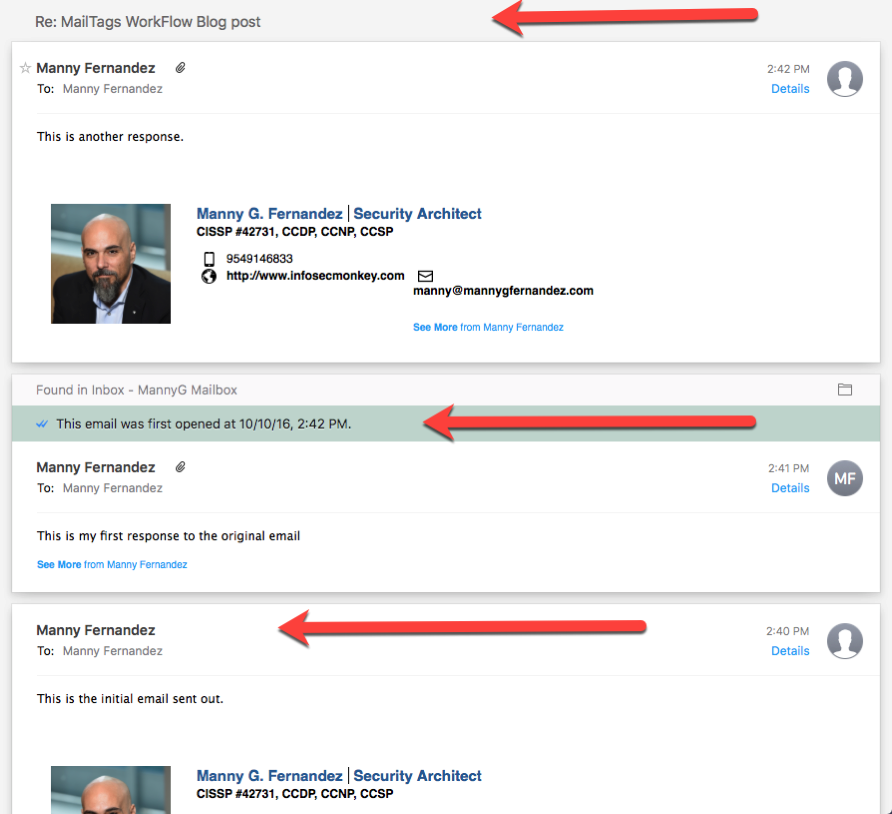
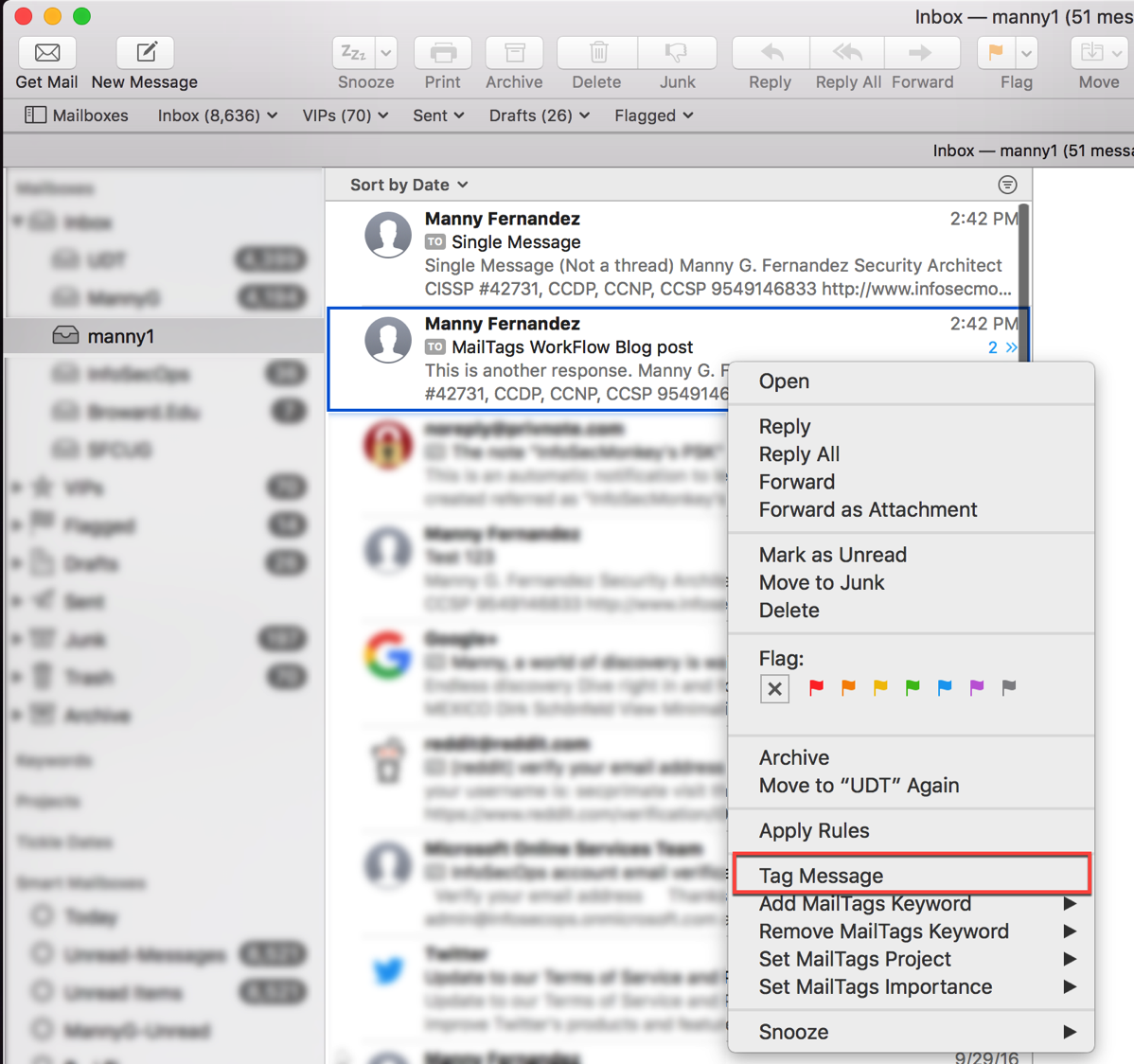
Here we see a thread I created as a test. When I identify emails in a thread that I want to keep track of, I simply click on the thread in the main window, not the preview pane on the right side. You can choose ‘Tag Message’
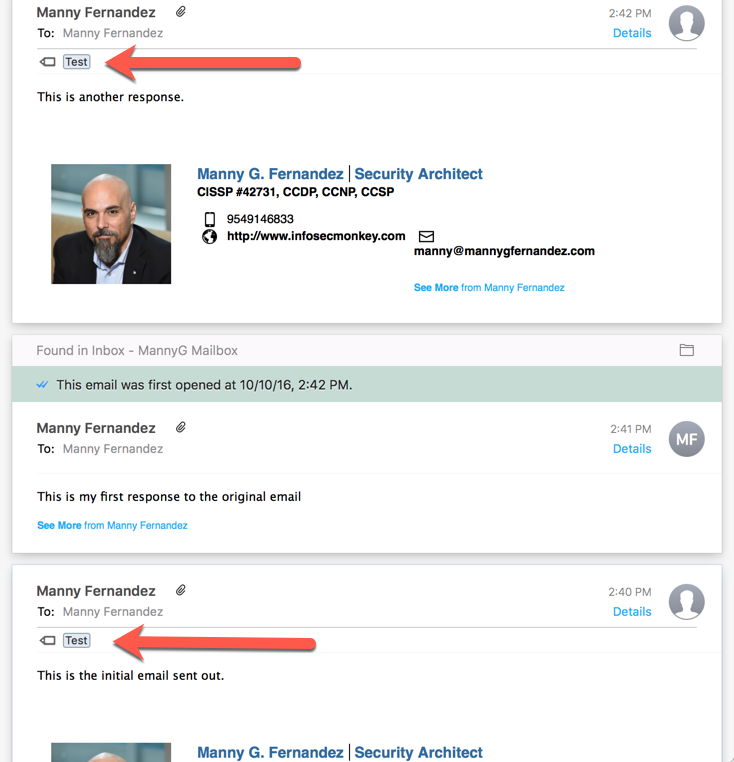
Once you tag the message from this location, you will essentially tag the entire thread.
Recent posts
-

-

DNS is one of those technologies that quietly underpins... Full Story
-

BGP issues on FortiGate firewalls usually trace back to... Full Story
-

Every time your laptop talks to your router, a... Full Story
-

If you've spent any time configuring NAT on a... Full Story
-

If you have spent any time configuring firewall policies... Full Story
-

High availability on FortiGate is one of those features... Full Story
-

If you've configured SD-WAN on a FortiGate, you've almost... Full Story
-

FortiLink is the management protocol that turns a FortiSwitch... Full Story
-

FortiSwitches are pretty rock solid from Mean Time Between... Full Story
-

This is a quicky tip. Have you ever gone... Full Story
-

DNS is one of those quiet pieces of internet... Full Story
-

This article is an updated version of the previous... Full Story
-

You will add ns2 as a secondary (slave) BIND9... Full Story
-

In the process of deploying my lab, I needed... Full Story
-

RFC 8805, used to be known as Self-Correcting IP... Full Story
-

Years back, I wrote an article about certificate pinning. ... Full Story
-

FortiGates have the ability to send alerts to Microsoft... Full Story
-

In this post, I am going to walk through... Full Story
-

Troubleshooting VoIP on a FortiGate can feel like trying... Full Story
-

Prior to FortiOS 7.0, there were three commands to... Full Story
-

In this post, I am going to go over... Full Story
-

What we are going to do: We are going... Full Story
-

Choosing between FGCP (FortiGate Clustering Protocol) and FGSP (FortiGate... Full Story
-

Creating a VLAN on macOS (The "Pro" Move) A... Full Story
-

This blog post explores the logic behind how macOS... Full Story
-

Pretty Fly for a Wi-Fi Tell My Wi-Fi Love... Full Story
-

Part of my daily gig is creating BoMs (Bill-of-Materials)... Full Story
-

ICMP introduces several security risks, but careful filtering, rate... Full Story
-

The command diag debug application dhcps -1 enables full... Full Story
-

In the world of FortiOS, execute tac report is... Full Story
-

LLDP; What is it The Link Layer Discovery Protocol... Full Story
-

What it actually does When you run diagnose fdsm... Full Story
-

Monkey Bites are bite-sized, high-impact security insights designed for... Full Story
-

I have run macOS in macOS with Parallels but... Full Story
-

Don't be confused with my other FortiNAC posts where... Full Story
-

This is the third session in a multi-part article... Full Story
-

Today I was configuring key-based authentication on a FortiGate... Full Story
-

Netcat, often called the "Swiss Army knife" of networking,... Full Story
-

At its core, IEEE 802.1X is a network layer... Full Story
-

In case you did not see the previous FortiNAC... Full Story
-

This is our 5th session where we are going... Full Story
-

Now that we have Wireshark installed and somewhat configured,... Full Story
-

The Philosophy of Packet Analysis Troubleshooting isn't about looking... Full Story
-

InfoSecMonkey Threat Response October 24, 2026 | No fluff.... Full Story
-

InfoSecMonkey Threat Response October 24, 2026 | No fluff.... Full Story
-

Plus what you actually get with FortiCare Essential, Premium... Full Story