
If you've spent any time configuring user authentication on... Full Story
By Manny Fernandez
April 3, 2023

Direct Access through Split Tunnel VPN
Use case: Customer has a Split Tunnel Enabled but wants to route certain FQDN or IP addresses via the local default gateway on the client side. In this case, it is to not put a burden on the VPN GW at the DC for traffic such as voice.
We are going to use the negate command (see negate article) which essentially means everything EXCEPT what is selected.
You will need to build your SSL VPN Portal as you normally would. I have two article that go through that process. Here is one with realms and one without.
Once the VPN Portal is completed, you will need to modify it.
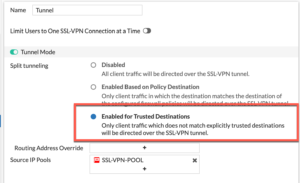
You will need to choose the Enable for trusted destinations button.
Next we will create the necessary policy
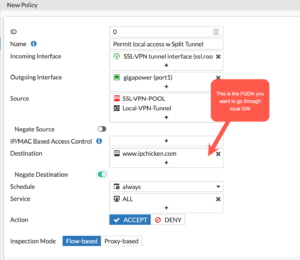
You will need to enter the FQDN or IP address you want to egress from the local client’s default gateway in the Destination field, and then choose Negate Destination toggle button. If you do not see this option, you will need to go to System then Feature Visibility then choose Policy Advanced Options.
NOTE: You can also enable this on the CLI by right clicking the policy after you are done or within the policy with the edit in cli from the right pane (if you are doing it from inside the policy)
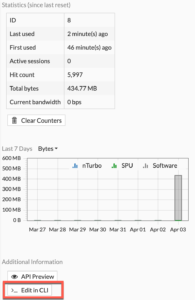
or on the drop-down from the Firewall Policy screen.
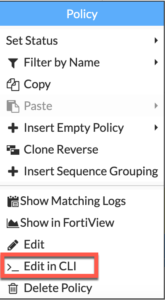
You can then enable the negate by entering the following command:
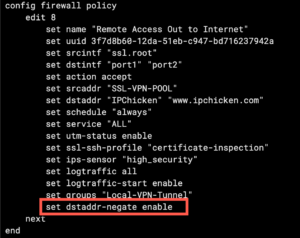
set dstaddr-negate enable
Once this is complete, edit the SSL VPN Portal from the cli as this command is only available from the cli with the config vpn ssl portal then editing the particular tunnel. My case edit Tunnel.
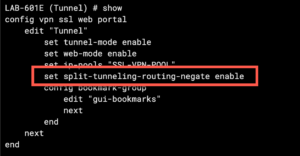
You will need to edit the portal you configured, and add the following command:
set split-tunneling-routing-negate enable
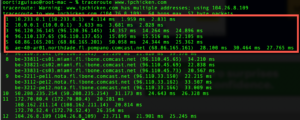
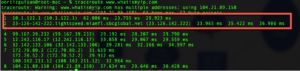
In my example, we sent all www.ipchicken.com traffic locally, while routing all other traffic through the SSL VPN.
In the following traceroute outputs, we can see the traffic routing through the Comcast circuit when he tracerouted to ipchicken.com
Next you will see the route when he routed to whatismyip.com going through the SBC path.
NOTE: You can add additional destination addresses in the policy to expand on what gets diverted to the local default gateway.
Thank you to Omar Ortiz for working with me on the PoC.
Recent posts
-

-

DNS is one of those technologies that quietly underpins... Full Story
-

BGP issues on FortiGate firewalls usually trace back to... Full Story
-

Every time your laptop talks to your router, a... Full Story
-

If you've spent any time configuring NAT on a... Full Story
-

If you have spent any time configuring firewall policies... Full Story
-

High availability on FortiGate is one of those features... Full Story
-

If you've configured SD-WAN on a FortiGate, you've almost... Full Story
-

FortiLink is the management protocol that turns a FortiSwitch... Full Story
-

FortiSwitches are pretty rock solid from Mean Time Between... Full Story
-

This is a quicky tip. Have you ever gone... Full Story
-

DNS is one of those quiet pieces of internet... Full Story
-

This article is an updated version of the previous... Full Story
-

You will add ns2 as a secondary (slave) BIND9... Full Story
-

In the process of deploying my lab, I needed... Full Story
-

RFC 8805, used to be known as Self-Correcting IP... Full Story
-

Years back, I wrote an article about certificate pinning. ... Full Story
-

FortiGates have the ability to send alerts to Microsoft... Full Story
-

In this post, I am going to walk through... Full Story
-

Troubleshooting VoIP on a FortiGate can feel like trying... Full Story
-

Prior to FortiOS 7.0, there were three commands to... Full Story
-

In this post, I am going to go over... Full Story
-

What we are going to do: We are going... Full Story
-

Choosing between FGCP (FortiGate Clustering Protocol) and FGSP (FortiGate... Full Story
-

Creating a VLAN on macOS (The "Pro" Move) A... Full Story
-

This blog post explores the logic behind how macOS... Full Story
-

Pretty Fly for a Wi-Fi Tell My Wi-Fi Love... Full Story
-

Part of my daily gig is creating BoMs (Bill-of-Materials)... Full Story
-

ICMP introduces several security risks, but careful filtering, rate... Full Story
-

The command diag debug application dhcps -1 enables full... Full Story
-

In the world of FortiOS, execute tac report is... Full Story
-

LLDP; What is it The Link Layer Discovery Protocol... Full Story
-

What it actually does When you run diagnose fdsm... Full Story
-

Monkey Bites are bite-sized, high-impact security insights designed for... Full Story
-

I have run macOS in macOS with Parallels but... Full Story
-

Don't be confused with my other FortiNAC posts where... Full Story
-

This is the third session in a multi-part article... Full Story
-

Today I was configuring key-based authentication on a FortiGate... Full Story
-

Netcat, often called the "Swiss Army knife" of networking,... Full Story
-

At its core, IEEE 802.1X is a network layer... Full Story
-

In case you did not see the previous FortiNAC... Full Story
-

This is our 5th session where we are going... Full Story
-

Now that we have Wireshark installed and somewhat configured,... Full Story
-

The Philosophy of Packet Analysis Troubleshooting isn't about looking... Full Story
-

In this guide Executive Summary Prerequisites: Which vi Do... Full Story
-

Objective: Strip blank and whitespace-only lines out of config... Full Story
-

In this guide Executive Summary Prerequisites and Architecture How... Full Story