
If you've spent any time configuring user authentication on... Full Story
By Manny Fernandez
June 19, 2026
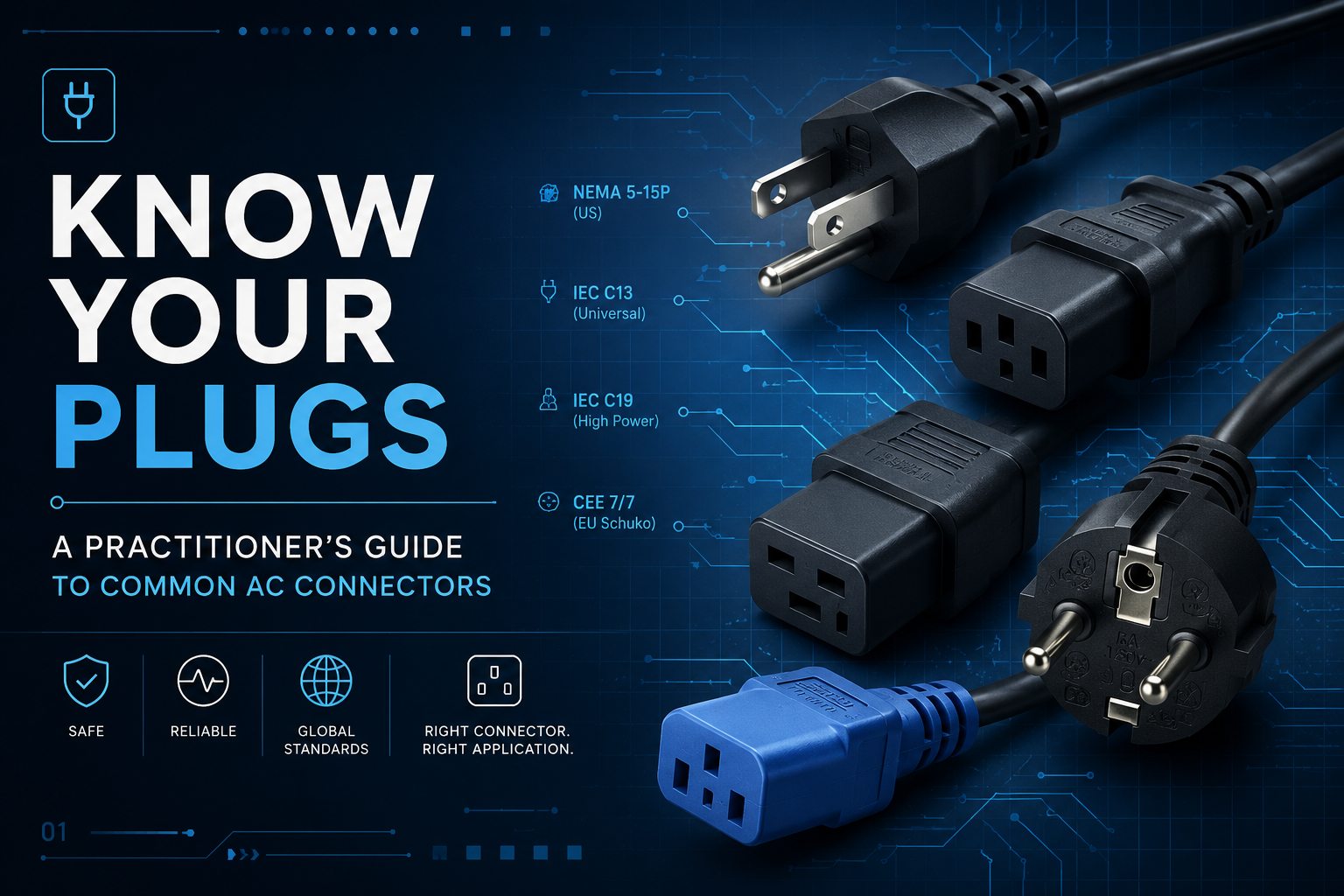
Know Your Plugs: A Practitioner’s Guide to Common AC Connectors
In this article, I will cover the basic AC plugs you are bound to run into. In “Know Your Plugs: A Practitioner’s Guide to Common AC Connectors” we cover NEMA & IEC, as well as the different NEMA wall outlets.
Practitioner cybersecurity, minus the fluff. But before the packets flow, something has to keep the power on, and in a server room, a lab, or a home rack, the humble AC connector is where a lot of avoidable mistakes hide. Plug the wrong cord into the wrong receptacle and you get anything from a dead PDU to a melted contact to a tripped branch circuit that takes a rack offline.
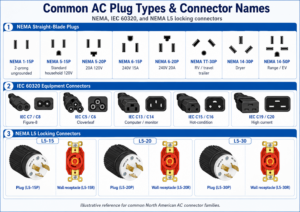
This guide walks the three connector families on the reference chart: NEMA straight-blade plugs, IEC 60320 equipment connectors, and NEMA L5 locking connectors. For each one you get what it is, where you actually use it, and just as important, where it bites you.
A quick orientation on naming. With NEMA devices, the number before the dash describes the configuration (voltage and grounding), the number after the dash is the amperage rating, and a trailing letter tells you the gender: P for plug (male), R for receptacle (female). So a 5-15R is the standard wall outlet that mates with a 5-15P cord. With IEC 60320 connectors, the convention flips: the odd number (C13, C19) is the connector that attaches to the cord and plugs into equipment, and the even number one higher (C14, C20) is the inlet built into the equipment or PDU.
Part 1: NEMA Straight-Blade Plugs
These are the everyday North American plugs. They are cheap, ubiquitous, and unlocking, which means they pull out if you tug the cord. That is a feature for safety and a liability for anything that must not lose power.
NEMA 1-15P (2-prong, ungrounded)
The classic two-blade plug with no ground pin, rated 15A at 125V. You still see it on lamps, phone chargers, and double-insulated consumer gadgets.
Use case: Low-draw, double-insulated devices that carry no exposed metal and need no safety ground.
Limitations and when not to use: No equipment ground means no protective bonding path, so never use it for anything with an exposed conductive chassis, anything in a wet location, or any IT or networking gear. In a rack or lab it has no place. If a device shipped with a 3-prong cord, do not “adapt” it down to two prongs to fit an old outlet.
NEMA 5-15P (standard household 120V)
The grounded three-prong plug everyone pictures when they hear “wall plug,” rated 15A at 125V. This is the workhorse for the vast majority of office and home equipment.
Use case: General-purpose 120V gear up to roughly 12A continuous (the 80 percent rule on a 15A circuit): workstations, monitors, small switches, consumer routers, single small UPS units.
Limitations and when not to use: A 15A branch circuit gives you about 1,440 usable watts after derating, which a populated rack will blow through quickly. Do not chain power strips off a single 5-15 to feed a full rack, and do not assume the wall circuit is dedicated. It also does not lock, so it is a poor choice for gear that travels, vibrates, or sits where a cleaner’s cart can catch the cord.
NEMA 5-20P (20A, 120V)
A 5-15 cousin rated for 20A at 125V. Its giveaway is one blade turned sideways (a T-shaped neutral), so it physically will not fit a 15A outlet, while a 20A outlet accepts both 15A and 20A plugs.
Use case: Higher-draw 120V single-phase loads: larger UPS units, mid-size PDUs, lab benches, and anything that needs more than a 15A circuit can safely deliver.
Limitations and when not to use: The sideways blade is a compatibility wall, not a suggestion. Do not file it down or adapt it to force it into a 15A receptacle, because that defeats the keying that protects a 15A circuit from a 20A load. And a 20A 120V circuit still tops out around 1,920 watts of capacity (about 1,536 usable continuous), so it is not a path to high-density power.
NEMA 6-15P (240V, 15A)
A 240V two-pole plug with ground, rated 15A. Both blades are horizontal. This is single-phase 240V, not the 120V most North American outlets carry.
Use case: 240V equipment in the 15A range: some lab gear, certain network and server appliances configured for 208/240V, larger workstations and shop tools.
Limitations and when not to use: It looks deceptively close to a 5-15 but carries double the voltage, so never assume a 6-series receptacle is a normal outlet. Plugging a 120V device into 240V is a destructive mistake. Confirm both the device’s input rating and the circuit before mating anything.
NEMA 6-20P (240V, 20A)
The 20A version of the 6-15, again 240V two-pole with ground, distinguished by a sideways blade. Common in data centers and labs running 208V single-phase.
Use case: Higher-draw 240V/208V single-phase loads: rack PDUs in many data centers, larger UPS units, heavier lab and shop equipment.
Limitations and when not to use: Same voltage caution as the 6-15, and the keyed blade again means no forcing it into the wrong receptacle. A 20A 240V circuit gives roughly 3,840 watts of capacity, so size the load and respect the 80 percent continuous rule rather than loading it to the breaker limit.
NEMA TT-30P (RV / travel trailer)
The “Travel Trailer” 30A 120V plug, three prongs, commonly called the RV 30. Despite being 30A it is only 120V, which trips people up constantly.
Use case: RV shore power and similar 120V 30A service for trailers and campers.
Limitations and when not to use: This is the single most misidentified connector here. It is not a 240V dryer or generator plug, and it is not interchangeable with the locking L5-30 even though both are 30A. Wiring it as 240V will destroy 120V appliances downstream. Outside of RV and mobile power contexts it has no business in a rack or lab.
NEMA 14-30P (dryer)
A 4-prong 30A plug carrying 120/240V (two hots, a neutral, and a ground). The modern replacement for the older, neutral-bonded 3-prong dryer plug.
Use case: Electric clothes dryers and similar 30A appliances that need both 240V (for the heating element) and 120V (for controls and the motor).
Limitations and when not to use: Not an IT connector and not a generic high-amp outlet, so do not press a dryer circuit into service for a rack. Do not back-adapt to the old 3-prong 10-30 standard, which bonds neutral and ground and is no longer code-compliant for new work. As always, match the appliance’s nameplate.
NEMA 14-50P (range / EV)
A 4-prong 50A plug, 120/240V, the big one. Long the standard for electric ranges and now the de facto outlet for Level 2 EV charging.
Use case: Electric ranges and ovens, welders, and Level 2 EV chargers (where a 14-50 receptacle on a properly sized 50A circuit is the common install).
Limitations and when not to use: A 14-50 must sit on a correctly sized and protected circuit with appropriately gauged wire; this is not a DIY-by-feel install, and a marginal receptacle on a continuous EV load is a known fire risk. Continuous loads like EV charging should run at 80 percent, so a 50A circuit supports a 40A continuous draw, not 50A flat. Do not assume a “14-50 outlet” in a garage was wired for continuous duty without verifying the breaker, wire gauge, and receptacle quality.
Part 2: IEC 60320 Equipment Connectors
These are the cord-to-equipment connectors, the ones you see on the back of nearly every server, PDU, switch, and PC. They are international and appliance-side, so the same C13/C14 pairing works whether the building delivers 120V or 230V. Remember the convention: the odd-numbered piece is on the cord, the even-numbered piece is the inlet on the gear.
IEC C7/C8 (Figure-8)
The small two-conductor connector shaped like a figure eight, ungrounded. C8 is the inlet, C7 the cord connector.
Use case: Low-power double-insulated electronics: laptop power bricks, game consoles, cameras, small audio gear, some printers.
Limitations and when not to use: No ground, low current rating (typically 2.5A), so it is strictly for small double-insulated devices. Never anywhere near rack power distribution or grounded equipment. Note that a polarized C7 variant exists, so do not force a polarized cord into a non-polarized inlet or vice versa.
IEC C5/C6 (Cloverleaf)
The three-pin “Mickey Mouse” or cloverleaf connector, grounded. C6 is the inlet, C5 the cord end.
Use case: Grounded laptop and notebook power supplies, some projectors and portable equipment that need an earth connection in a compact form.
Limitations and when not to use: Modest current rating (around 2.5A), so it is for small grounded devices only, not distribution or anything drawing real current. It is not interchangeable with the larger C13 family despite both being three-pin; do not try to adapt between them.
IEC C13 / C14 (computer / monitor)
The connector you will touch more than any other in IT. C14 is the inlet on the device or PDU, C13 is the cord connector, grounded, rated 10A (international) and commonly treated as 15A on North American cordage.
Use case: The backbone of rack power: servers, switches, monitors, most PDUs, and UPS outputs all use C13/C14. A C14 inlet on a PDU feeds a C13-terminated cord to each device.
Limitations and when not to use: Rated to 10A, so it is not for the heaviest single-server or blade-chassis loads, which is exactly what C19/C20 exists for. C13 connectors do not lock by default, so in a dense, vibration-prone, or frequently serviced rack a tugged or sagging cord can back partly out and cause an intermittent power fault. Where that risk matters, use locking C13 cordage (often branded P-Lock or similar) or secure the cords. Do not exceed the cord’s and connector’s rating just because the PDU has spare outlets.
IEC C15 / C16 (hot-condition)
A close relative of C13/C14 with a notch (a keyway difference) that makes it rated for higher-temperature operation. C16 is the inlet, C15 the cord connector.
Use case: Equipment that runs hot at the connector: some networking and storage gear, kettles and appliances abroad, and devices the manufacturer specifically specs for C15.
Limitations and when not to use: The keying matters. A C15 cord fits a C16 inlet and a C13 inlet, but a C13 cord will not seat in a C16 inlet, by design, because that inlet expects the higher-temp connector. Do not try to substitute a standard C13 cord on equipment that calls for C15, and do not force the keyed connectors. Match what the device’s inlet actually is.
IEC C19 / C20 (high current)
The big rectangular IEC connector, rated 16A (international) and commonly 20A on North American cordage. C20 is the inlet, C19 the cord connector.
Use case: High-draw equipment and distribution: large servers, blade chassis, big UPS units, and the input on many higher-capacity rack PDUs. A C20 inlet on a PDU is typically fed from an upstream 20A source.
Limitations and when not to use: It is sized for real current, so it is overkill (and physically bulky) for small devices that a C13 handles fine. Like the C13, the standard version does not lock, so for critical high-draw feeds use locking C19/C20 cordage. And do not assume a C19 cord lets you ignore the branch circuit math: a C19 feed is only as good as the 20A circuit and PDU behind it.
Part 3: NEMA L5 Locking Connectors
The L5 family is the answer to the single biggest weakness of straight-blade plugs: they fall out. An L locking connector inserts and then twists a partial turn so the blades hook behind the receptacle contacts and physically cannot pull straight out. The “L5” series is 125V, 2-pole, 3-wire (hot, neutral, ground). As before, P is the plug and R is the receptacle.
This is the connector family you want anywhere an accidental disconnect is unacceptable: live racks, stage and event power, generators, and any cord run where someone might snag it.
NEMA L5–15 (L5-15P plug / L5-15R receptacle)
The locking equivalent of the 5-15, rated 15A at 125V. Twist-lock instead of straight-blade.
Use case: 120V 15A loads that must not lose power from an accidental tug: lab benches, some networking gear, AV and stage equipment, temporary power where cords get walked on.
Limitations and when not to use: Same 15A ceiling as the 5-15, so it solves the disconnect problem, not the capacity problem; do not expect more power just because it locks. It needs matching locking receptacles, so it is not a drop-in for a standard wall outlet without the right device installed. The connector is bulkier and pricier than a straight blade, which is the trade-off for retention.
NEMA L5–20 (L5–20P plug / L5–20R receptacle)
The 20A version, locking, 125V. The middle child and a very common choice for rack PDU input and stage power.
Use case: 120V 20A locked feeds: rack PDU inputs in many installations, event and broadcast power, and any 20A 120V load where a secure connection matters.
Limitations and when not to use: Capped at 20A 120V (roughly 1,920W capacity, about 1,536W usable continuous), so it is not a high-density power answer; that is what 208/240V distribution is for. It is keyed differently from the L5-15 and L5-30, so an L5-20 cord will not mate with an L5-15 or L5-30 receptacle. Match the device exactly rather than hunting for an adapter.
NEMA L5–30 (L5–30P plug / L5–30R receptacle)
The 30A locking connector, 125V. The heavy hitter of the 120V locking line.
Use case: 120V 30A locked feeds: larger portable generators, RV and mobile power runs that need a secure twist-lock, higher-draw single-phase 120V distribution and event power.
Limitations and when not to use: This is the connector most often confused with the TT-30 RV plug because both are “30A 120V,” but they are physically different (locking vs straight-blade) and not interchangeable; verify which one your generator or inlet actually has. It is still 120V, so a 30A rating does not make it a 240V connector, and at 30A 120V you are near the practical ceiling of single-phase 120V distribution. For genuinely heavy loads, move to 240V rather than pushing more current at 120V.
Field Rules That Save You
A few principles cut across all three families:
The number after the dash on a NEMA device is amperage, not voltage. A “30A” plug can be 120V (TT-30, L5-30) or 240V (14-30), and confusing the two destroys equipment. Always read voltage and configuration, never just the amp number.
Keyed and sideways blades exist on purpose. When a plug will not fit, that mismatch is protecting a circuit or a device. Filing, forcing, or adapting around keying defeats the safety design and is how you put a 120V device on 240V or a 20A load on a 15A circuit.
Derate continuous loads to 80 percent. A 15A circuit is good for about 12A continuous, a 20A for about 16A, a 50A for 40A. Sizing a rack or an EV charger to the breaker number rather than the continuous number is how you nuisance-trip or, worse, overheat a connection.
Locking connectors solve retention, not capacity. An L5-20 carries exactly as much as a 5-20; the lock just keeps it seated. Reach for locking connectors where an accidental disconnect is the risk, and reach for higher voltage where total power is the risk.
When uptime depends on a cord staying in, design for it. In a production rack, that means C13/C19 locking cordage or L-series feeds, labeled circuits, and a load budget you have actually added up, not estimated. The connector is the last link in the chain, and it is the cheapest place to prevent an outage.
Recent posts
-

-

DNS is one of those technologies that quietly underpins... Full Story
-

BGP issues on FortiGate firewalls usually trace back to... Full Story
-

Every time your laptop talks to your router, a... Full Story
-

If you've spent any time configuring NAT on a... Full Story
-

If you have spent any time configuring firewall policies... Full Story
-

High availability on FortiGate is one of those features... Full Story
-

If you've configured SD-WAN on a FortiGate, you've almost... Full Story
-

FortiLink is the management protocol that turns a FortiSwitch... Full Story
-

FortiSwitches are pretty rock solid from Mean Time Between... Full Story
-

This is a quicky tip. Have you ever gone... Full Story
-

DNS is one of those quiet pieces of internet... Full Story
-

This article is an updated version of the previous... Full Story
-

You will add ns2 as a secondary (slave) BIND9... Full Story
-

In the process of deploying my lab, I needed... Full Story
-

RFC 8805, used to be known as Self-Correcting IP... Full Story
-

Years back, I wrote an article about certificate pinning. ... Full Story
-

FortiGates have the ability to send alerts to Microsoft... Full Story
-

In this post, I am going to walk through... Full Story
-

Troubleshooting VoIP on a FortiGate can feel like trying... Full Story
-

Prior to FortiOS 7.0, there were three commands to... Full Story
-

In this post, I am going to go over... Full Story
-

What we are going to do: We are going... Full Story
-

Choosing between FGCP (FortiGate Clustering Protocol) and FGSP (FortiGate... Full Story
-

Creating a VLAN on macOS (The "Pro" Move) A... Full Story
-

This blog post explores the logic behind how macOS... Full Story
-

Pretty Fly for a Wi-Fi Tell My Wi-Fi Love... Full Story
-

Part of my daily gig is creating BoMs (Bill-of-Materials)... Full Story
-

ICMP introduces several security risks, but careful filtering, rate... Full Story
-

The command diag debug application dhcps -1 enables full... Full Story
-

In the world of FortiOS, execute tac report is... Full Story
-

LLDP; What is it The Link Layer Discovery Protocol... Full Story
-

What it actually does When you run diagnose fdsm... Full Story
-

Monkey Bites are bite-sized, high-impact security insights designed for... Full Story
-

I have run macOS in macOS with Parallels but... Full Story
-

Don't be confused with my other FortiNAC posts where... Full Story
-

This is the third session in a multi-part article... Full Story
-

Today I was configuring key-based authentication on a FortiGate... Full Story
-

Netcat, often called the "Swiss Army knife" of networking,... Full Story
-

At its core, IEEE 802.1X is a network layer... Full Story
-

In case you did not see the previous FortiNAC... Full Story
-

This is our 5th session where we are going... Full Story
-

Now that we have Wireshark installed and somewhat configured,... Full Story
-

The Philosophy of Packet Analysis Troubleshooting isn't about looking... Full Story
-

InfoSecMonkey Threat Response October 24, 2026 | No fluff.... Full Story
-

InfoSecMonkey Threat Response October 24, 2026 | No fluff.... Full Story
-

Plus what you actually get with FortiCare Essential, Premium... Full Story