
If you've spent any time configuring user authentication on... Full Story
By Manny Fernandez
November 7, 2026

Sales Forecasting Metrics Explained: A Sales Engineer’s Field Guide
Closed, Commit, Best Case, Pipeline, and the Landing number, decoded for the SE who has to defend the technical win behind every one of them.
Executive Summary
Every Monday forecast call runs on the same vocabulary: Closed, Commit, Best Case, Pipeline, Landing. Account executives live in these numbers. Sales engineers usually hear them second hand, and that is a problem, because the SE is the person who knows whether the technical win behind a Commit deal is real. This post decodes the sales forecasting metrics used in enterprise pipeline reviews, walks through one quarter of worked math, explains why open pipeline gets flushed at quarter end, and then lays out the best practices an SE should run to make the forecast honest.
| Item | Detail |
|---|---|
| Objective | Understand the seven core forecast categories, do the math on a real-looking quarter, and run an SE-side forecast discipline that protects the number |
| Target audience | Sales engineers, solutions architects, and pre-sales leaders who sit on forecast calls; new AEs who want the SE view |
| Format | Reference post: definitions, worked example, best-practice playbook, gotchas |
Prerequisites and Assumed Knowledge
- You know what an opportunity is in your CRM (Salesforce, Dynamics, HubSpot) and that each one carries an amount, a close date, a stage, and a forecast category.
- You attend, or feed numbers into, a weekly or biweekly forecast call.
- You own technical validation on your deals: discovery, demo, POC or POV, design, and the Bill of Materials.
The table below is the cheat sheet. Each row is unpacked in the next section.
| Metric | What it counts | Confidence | Time view |
|---|---|---|---|
| Closed | Signed, booked revenue | 100% | Historical |
| Cumulative Closed | Running total of Closed | 100% | QTD or YTD |
| Closed Commit | Closed + open Commit deals | Closed 100%, Commit 75%+ | Current period |
| Closed Commit Best Case | Closed Commit + Best Case deals | Closed Commit + >50% deals | Current period |
| Total Pipeline | All open deals, every stage | Mixed | Current period |
| Commit Forecast | The number the team calls and is held to. Must have 75%+ Opps to support | Highest | Current period |
| Landing Target Forecast | AE/Leadership’s projected finish “The Gut Check” | Weighted | Quarter or year end |
Part 1: Sales Forecasting Metrics Explained
In enterprise forecasting these categories track revenue as it moves from early prospecting to finalized bookings. Think of them as nested buckets: each one adds a less certain layer on top of the one below it.
1. Closed
Revenue from deals that are officially won: contract signed, PO received, order booked. This is actualized, historical data. Nothing about it is a prediction.
SE angle: A deal is not Closed because the customer said yes on a call. It is Closed when the order books. If the BoM has a wrong SKU and the order bounces from operations, it is still open.
2. Cumulative Closed
The running quarter-to-date (QTD) or year-to-date (YTD) total of all closed-won revenue up to today. It is the line that climbs on the attainment chart. Leadership watches its slope.
3. Closed Commit
A blended number: your Closed revenue plus the open deals in the current period forecast as Commit. A Commit deal is one the rep and management are 75% or more confident will close. Closed Commit is the floor the team expects to land on if nothing moves to closed lost.
4. Closed Commit Best Case
Closed Commit plus the Best Case deals. Best Case is upside: opportunities that have a higher probability to close if certain conditions are met (budget released, legal finishes, the POC passes), always treated as 50% – 74% confidence. This is the ceiling scenario for the period.
5. Total Pipeline
The aggregate value of every open deal in the timeframe, across every stage of the funnel, regardless of how early or late it is. Total Pipeline is a measure of opportunity, not a forecast. It feeds coverage ratios (pipeline divided by the remaining quota gap), which tell you whether there is enough raw material to hit the number.
6. Commit Forecast
The specific revenue amount the team commits to delivering by the end of the period. It includes only the highest-confidence deals and excludes early-stage or speculative opportunities. The difference from Closed Commit is ownership: Closed Commit is a CRM rollup, while the Commit Forecast is the number a manager says out loud and is held to. A manager may call below the rollup if a Commit deal looks shaky, or above it if they expect a deal to be pulled forward.
7. Landing Target Forecast
Leadership’s best estimate of where revenue will actually finish for the quarter or year. It is usually calculated as:
Landing = Closed + Commit + (weighted % x Best Case) + (weighted % x remaining Pipeline)The weights come from historical conversion rates per category. Landing is the number finance plans against, so it is the one that hurts most when it is wrong.
Worked Example: One Quarter, Every Metric
Here is a single territory in week 9 of a 13-week quarter, with a $4,000,000 quota. All figures are illustrative.
| CRM category | Open or booked | Amount |
|---|---|---|
| Closed (QTD) | Booked | $1,800,000 |
| Commit | Open | $900,000 |
| Best Case | Open | $700,000 |
| Pipeline (early stage) | Open | $2,600,000 |
Now the metrics:
| Metric | Math | Result |
|---|---|---|
| Closed | Booked to date | $1,800,000 |
| Cumulative Closed | QTD running total | $1,800,000 (45% of quota) |
| Closed Commit | 1,800,000 + 900,000 | $2,700,000 (67.5%) |
| Closed Commit Best Case | 2,700,000 + 700,000 | $3,400,000 (85%) |
| Total Pipeline | 900,000 + 700,000 + 2,600,000 | $4,200,000 open |
| Commit Forecast | Manager haircuts one $100,000 Commit deal | $2,600,000 called |
| Landing Target | 1,800,000 + 900,000 + (50% x 700,000) + (5% x 2,600,000) | $3,180,000 (79.5%) |
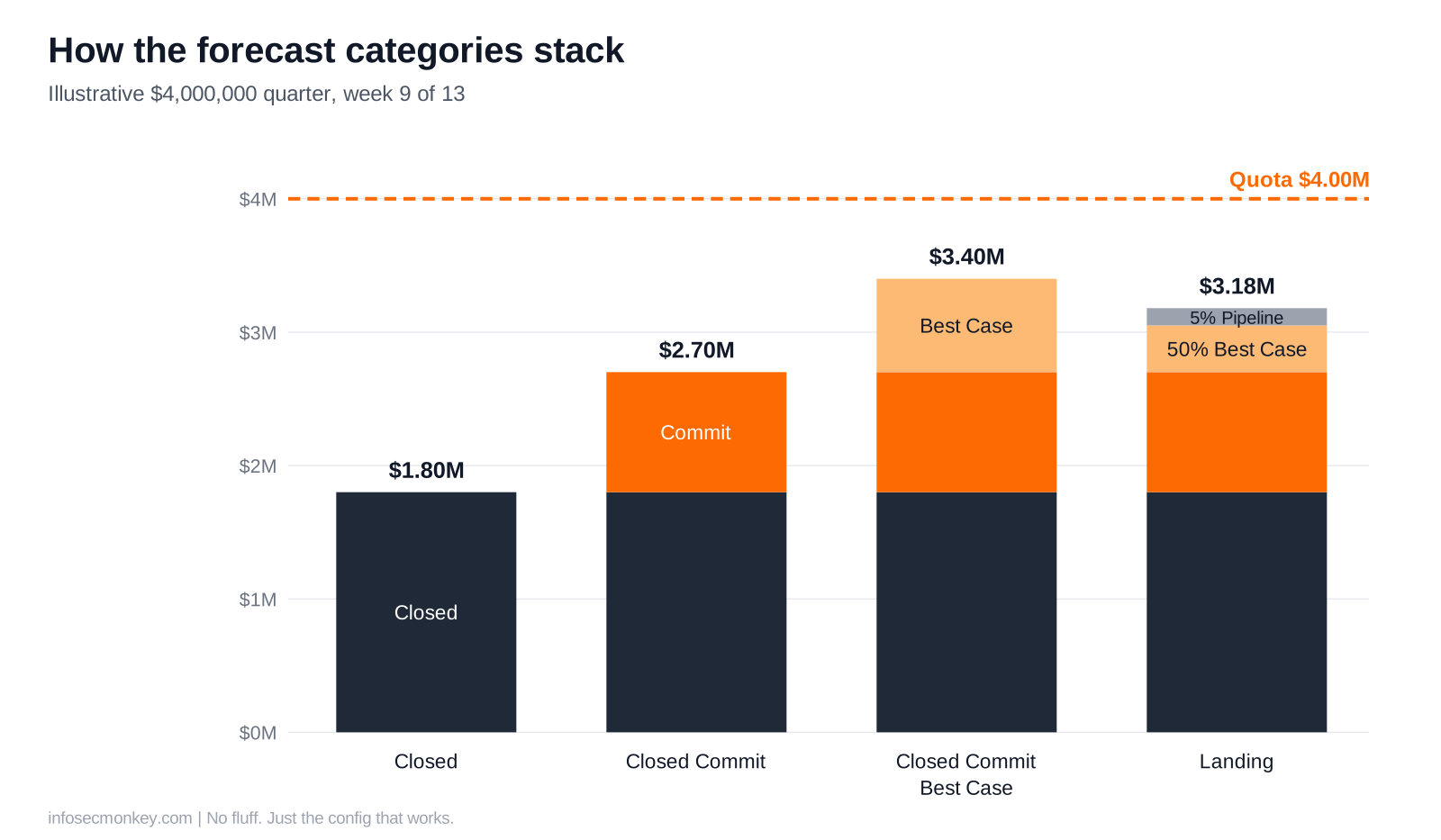
Two numbers jump out. First, the gap to quota is $2,200,000 (4,000,000 minus 1,800,000), and open pipeline is $4,200,000, which is about 1.9x coverage. Most enterprise teams want 3x at the start of a quarter, so this territory is thin. Second, even if every Commit and Best Case deal closes, the territory lands at 85%. Hitting 100% requires early-stage pipeline to convert inside four weeks, which rarely happens. That is the conversation the forecast call will have, and the SE should walk in already knowing it.
Why Pipeline Is Removed at the End of the Quarter
When a fiscal quarter begin, most organizations flush or zero out the open early-stage pipeline still sitting in that period. The reason is simple: pipeline represents future potential, not current-period delivery.
- Time horizon expiration. Once the quarter starts, the window to close deals for that quota period ends with it. Open pipeline left in that bucket is no longer actionable for that period, so it must be pushed (rolled) to the next quarter with a new, defensible close date.
- Forecast accuracy and cleanliness. Stale pipeline left in a closed period distorts historical reporting and win-rate analytics. Flushing it means actual performance is measured strictly against real commitments and closed revenue.
For the SE, the flush has a practical consequence: every deal that rolls needs its technical status re-validated. A POC that finished in August does not prove much in November if the customer’s requirements, champion, or competitor have changed.
Part 2: Best Practices for the Sales Engineer
The AE owns the number. The SE owns whether the number is technically true. These are the habits that make that ownership real.
1. Map your technical milestones to forecast categories
Agree with your AEs on what technical state a deal must be in before it can sit in each category. Write it down once and use it every week.
| Forecast category | Minimum technical state (SE gate) |
|---|---|
| Pipeline | Discovery done, pain and use case documented, technical stakeholders named |
| Best Case | Solution designed, demo or POC scoped with written success criteria and a date |
| Commit | Technical win declared by the customer, BoM validated, no open technical objections |
| Closed | Order booked with the correct SKUs, licensing, and contract terms |
Rule: If a deal is in Commit and the technical win is not declared, say so on the call. A Commit deal with an open POC is a Best Case deal wearing a costume.
2. Run a weekly technical status on every Commit and Best Case deal
Keep a one-line status per deal before the forecast call. Green means technically clean. Yellow means a known gap with an owner and a date. Red means the technical win is at risk. Update it in the CRM, not in your head, so the AE and manager see it without asking.
Deal: ACME HQ Refresh | Cat: Commit | $420,000 | Close: 12/15
Tech: YELLOW | Gap: HA failover test pending | Owner: SE | Due: 11/20
Risk if missed: slips to next quarter, not lost3. Give every POC exit criteria and an end date
- Success criteria are written, measurable, and signed off by the customer before the gear ships.
- The POC end date lands at least three weeks before the forecast close date, so there is time for procurement.
- Do not start a new POC in the last three weeks of the quarter for a deal forecast in that quarter. Either move the close date or move the deal to Best Case.
4. Make the BoM part of the forecast, not an afterthought
A Commit deal with an unvalidated Bill of Materials is not the correct forecast category. Wrong SKUs, missing support contracts, or a licensing model the customer did not expect will kick the order back at the worst possible moment. Validate the BoM, confirm the quote has not expired, and check product lead times before the deal enters Commit.
5. Know the quarter-end logistics
- Distributor and partner order processing cutoffs, which are usually earlier than the last day of the quarter.
- Quote expiration dates and any pricing changes scheduled for the new quarter.
- Hardware lead times and whether the customer needs product on site before they sign.
- Customer procurement and legal cycles, especially their own fiscal year end and approval thresholds.
6. Flag risk early and plainly
Bad news gets worse with age. If a technical issue threatens a Commit deal, raise it the week you learn about it, with a mitigation plan. Avoid both failure modes: happy ears (repeating the customer’s optimism as fact) and sandbagging (hiding a deal you know will close to look like a hero later). Both destroy trust in the forecast.
7. Spend SE capacity by forecast category
Time is the SE’s only real resource. A useful split for the back half of the quarter:
| Category | SE focus | Typical share of time |
|---|---|---|
| Commit | Remove every remaining technical blocker; support the order | 40 to 50% |
| Best Case | Close the specific condition that keeps it out of Commit | 30 to 40% |
| Pipeline | Discovery and design that builds next quarter | 10 to 20% |
Never drop pipeline work to zero. The quarter-end flush rolls deals forward, and next quarter’s coverage is built now.
8. Keep CRM hygiene on the technical fields
Update technical stage, competitor, POC status, and next step after every customer touch. Clean data is what lets leadership trust the Landing number, and it is what keeps the post-flush pipeline honest.
Verification: The SE Forecast Call Self-Check
Run this before every forecast call. If you cannot answer yes to each line for every Commit deal, you have something to raise.
- The customer has declared the technical win, in writing or on a call with a named decision maker.
- Every POC has passed its written success criteria.
- The BoM is validated, the quote is current, and lead times fit the close date.
- There are no open technical objections, security reviews, or integration questions.
- The CRM technical status and next step are dated this week.
What success looks like: your Commit deals close in the period at 75% or better, and when one slips, nobody on the call is surprised because you flagged it weeks earlier.
Troubleshooting and Gotchas
Gotcha 1: Treating Total Pipeline as a forecast
Symptom: The team reports $4.2M in pipeline against a $4M quota and feels safe. Cause: Pipeline is opportunity, not prediction; early-stage deals convert at single-digit rates inside a quarter. Fix: Compare the remaining gap to Closed Commit Best Case first, then check coverage. If Closed Commit Best Case is below quota, the quarter depends on deals that have not been technically validated yet.
Gotcha 2: Double counting Closed
Symptom: Someone adds Closed, Closed Commit, and Closed Commit Best Case together. Cause: The categories are nested, not additive. Fix: Each metric already includes the one below it. Add only the open categories on top of Closed, as in the worked example.
Gotcha 3: Stale close dates after the flush
Symptom: Rolled deals keep their old close date plus 90 days and quietly become next quarter’s fake pipeline. Cause: Nobody re-validated them. Fix: Re-qualify every rolled deal within two weeks: confirm the champion, the requirement, the competitor, and the technical status, then set a close date tied to a real customer event.
Bottom line: Forecasting is a technical exercise wearing a sales badge. The AE knows when the customer wants to buy. The SE knows whether they can. Put both in the CRM every week and the Landing number stops being a guess.
Recent posts
-

-

DNS is one of those technologies that quietly underpins... Full Story
-

BGP issues on FortiGate firewalls usually trace back to... Full Story
-

Every time your laptop talks to your router, a... Full Story
-

If you've spent any time configuring NAT on a... Full Story
-

If you have spent any time configuring firewall policies... Full Story
-

High availability on FortiGate is one of those features... Full Story
-

If you've configured SD-WAN on a FortiGate, you've almost... Full Story
-

FortiLink is the management protocol that turns a FortiSwitch... Full Story
-

FortiSwitches are pretty rock solid from Mean Time Between... Full Story
-

This is a quicky tip. Have you ever gone... Full Story
-

DNS is one of those quiet pieces of internet... Full Story
-

This article is an updated version of the previous... Full Story
-

You will add ns2 as a secondary (slave) BIND9... Full Story
-

In the process of deploying my lab, I needed... Full Story
-

RFC 8805, used to be known as Self-Correcting IP... Full Story
-

Years back, I wrote an article about certificate pinning. ... Full Story
-

FortiGates have the ability to send alerts to Microsoft... Full Story
-

In this post, I am going to walk through... Full Story
-

Troubleshooting VoIP on a FortiGate can feel like trying... Full Story
-

Prior to FortiOS 7.0, there were three commands to... Full Story
-

In this post, I am going to go over... Full Story
-

What we are going to do: We are going... Full Story
-

Choosing between FGCP (FortiGate Clustering Protocol) and FGSP (FortiGate... Full Story
-

Creating a VLAN on macOS (The "Pro" Move) A... Full Story
-

This blog post explores the logic behind how macOS... Full Story
-

Pretty Fly for a Wi-Fi Tell My Wi-Fi Love... Full Story
-

Part of my daily gig is creating BoMs (Bill-of-Materials)... Full Story
-

ICMP introduces several security risks, but careful filtering, rate... Full Story
-

The command diag debug application dhcps -1 enables full... Full Story
-

In the world of FortiOS, execute tac report is... Full Story
-

LLDP; What is it The Link Layer Discovery Protocol... Full Story
-

What it actually does When you run diagnose fdsm... Full Story
-

Monkey Bites are bite-sized, high-impact security insights designed for... Full Story
-

I have run macOS in macOS with Parallels but... Full Story
-

Don't be confused with my other FortiNAC posts where... Full Story
-

This is the third session in a multi-part article... Full Story
-

Today I was configuring key-based authentication on a FortiGate... Full Story
-

Netcat, often called the "Swiss Army knife" of networking,... Full Story
-

At its core, IEEE 802.1X is a network layer... Full Story
-

In case you did not see the previous FortiNAC... Full Story
-

This is our 5th session where we are going... Full Story
-

Now that we have Wireshark installed and somewhat configured,... Full Story
-

The Philosophy of Packet Analysis Troubleshooting isn't about looking... Full Story
-

No fluff. Just the config that works. Executive Summary... Full Story
-

INFOSECMONKEY | CVE BRIEF | NO FLUFF. JUST THE... Full Story
-

APT CVE-2026-109518: How a Download Retry Lets an Attacker... Full Story